Short answer: A foreign national arrested for drugs at Istanbul Airport can be held in police custody (gözaltı) for up to 24 hours, plus up to 12 hours for transfer to a judge; in collective cases the limit can reach four days. The person must get a lawyer, an interpreter and consular notification. A criminal judge then decides on pre-trial detention or release under judicial control.
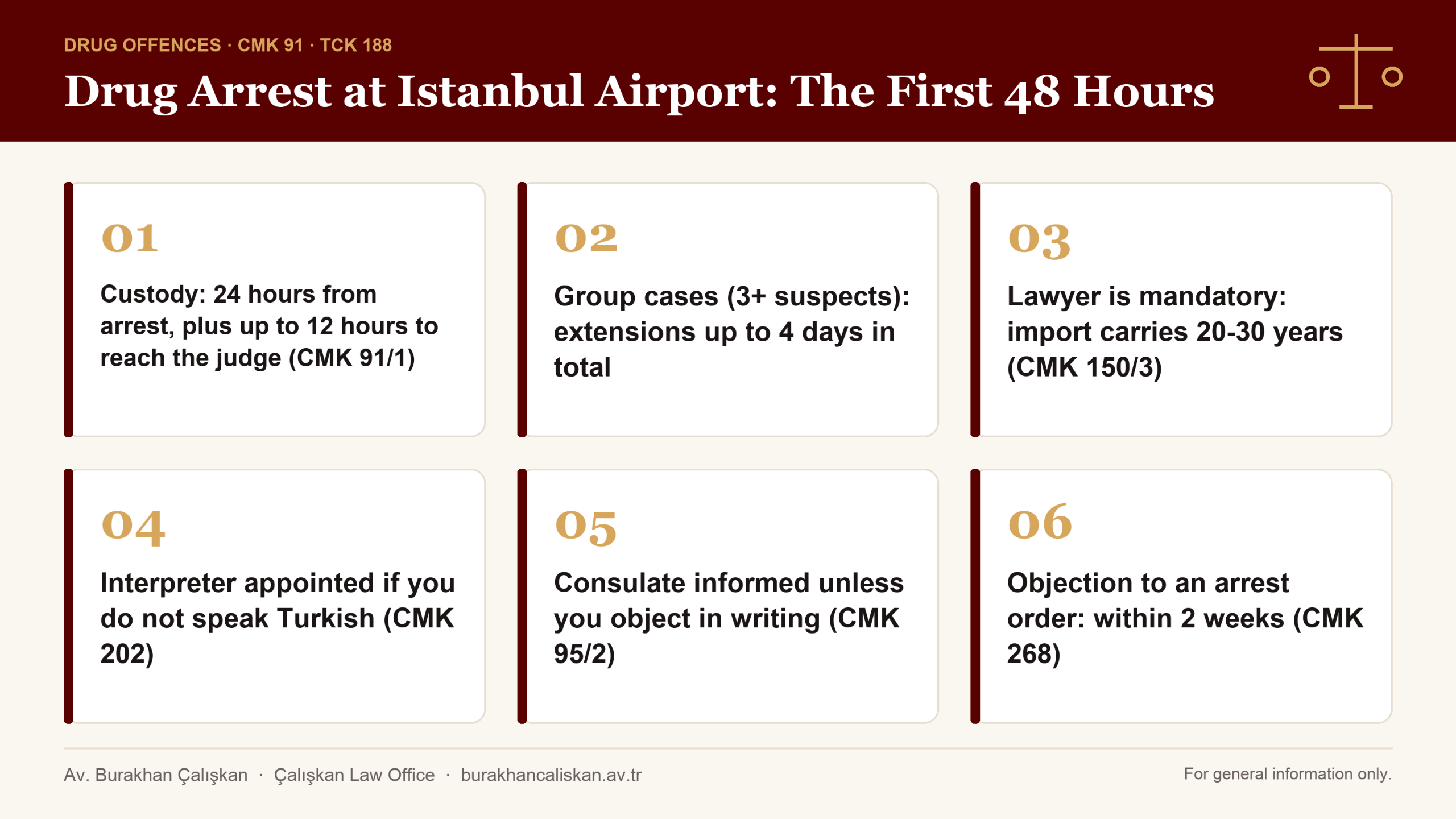
- Police custody (gözaltı) is limited to 24 hours from arrest, plus up to 12 hours to reach the nearest judge; collective cases can reach four days.
- Because drug import carries 20 to 30 years, a lawyer must be present even if the suspect does not ask for one.
- An interpreter is appointed for anyone who cannot follow Turkish, and the consulate is informed unless the person objects in writing.
- A criminal judgeship of peace decides on pre-trial detention or judicial control; an objection can be filed within two weeks.
This guide explains what Turkish law says about the first 48 hours after a drug arrest at Istanbul Airport: custody, lawyer, interpreter, consulate, the charges under the Turkish Penal Code (TCK) and the judge’s first decision.
Statements given in custody stay in the file and are assessed at trial. To get information about your case, you can call or send a WhatsApp message.
What happens when drugs are found on a passenger at Istanbul Airport?
When drugs are found on a passenger at Istanbul Airport, customs enforcement officers or airport police seize the substance, search the luggage and the person, and record everything in an incident and seizure report. A field test gives a first indication, but the charge later rests on an expert laboratory report identifying the substance and its net weight.
Cases often start with a risk analysis, a sniffer dog or an X-ray of the suitcase. If capsules are suspected inside the body, an internal examination needs a judge’s decision (or the prosecutor’s in urgent cases) and must be done by a doctor without risk to health (Code of Criminal Procedure, CMK, Article 75).
How long can police hold a foreigner in custody in Turkey?
Police custody in Turkey cannot exceed 24 hours from the moment of arrest, excluding the time needed to bring the person to the nearest judge, which itself cannot exceed 12 hours (CMK Article 91/1 (Turkish)). Longer custody is allowed only for collective offences, meaning offences committed by three or more people.
In collective offences the prosecutor may extend custody in writing, one day at a time, for up to three days. For drug trafficking caught in the act, the person must reach a judge within 48 hours, or four days in collective offences (Article 91/4). Custody can be challenged before the criminal judgeship of peace (sulh ceza hâkimliği).
Which rights must the police explain, and is a lawyer mandatory?
Turkish police must explain a detained person’s legal rights immediately after the arrest (CMK Article 90/4). Before any statement, Article 147 requires that the suspect be told the accusation, the right to choose a lawyer, the right to remain silent, the right to request evidence and that a relative will be informed.
For a drug import suspect the lawyer is not optional, because import under TCK Article 188/1 carries a minimum of 20 years:
“In investigations and prosecutions concerning offences punishable by imprisonment with a lower limit of more than five years, the provision of the second paragraph shall apply.” (CMK Article 150/3, unofficial translation; the second paragraph requires a lawyer to be appointed without a request)
Talks with the lawyer are confidential (Article 154/1). Only in organised drug trafficking may a judge restrict the lawyer meeting for 24 hours, and no statement may be taken during that time (Article 154/2).
Will an interpreter be provided if I do not speak Turkish?
An interpreter must be appointed when a suspect cannot express himself or herself in Turkish. Article 202 of the Code of Criminal Procedure applies this rule during the investigation too, and the interpreter is appointed by the judge or the public prosecutor.
A foreign defendant was heard at the final hearing without an interpreter and without being asked whether he understood Turkish. Citing Article 6/3 of the European Convention on Human Rights and CMK Article 202, the Chamber held that the right of defence had been restricted and quashed the judgment.
Will my embassy or consulate be informed of the arrest?
Yes. Turkish law requires the authorities to notify the consulate of a detained foreign national’s country unless the person objects in writing (CMK Article 95/2). This goes further than the Vienna Convention on Consular Relations, which makes notification depend on the detainee’s request.
Türkiye acceded to the Convention on 19 February 1976, according to the United Nations Treaty Collection. Under Article 36 of the Convention text, the authorities “shall inform the person concerned without delay of his rights under this subparagraph”. Consular officers may visit, correspond and arrange legal representation, but cannot secure release.
Which offence applies: import, transit transport or personal use?
The charge after an airport drug arrest depends on whether the drugs entered Turkey and for what purpose. Importing drugs without a licence is punished under TCK Article 188/1 (Turkish) with 20 to 30 years’ imprisonment and a judicial fine of 2,000 to 20,000 days; carrying or holding drugs for trade inside Turkey falls under Article 188/3, with at least 10 years.
The Court of Cassation draws the line at passport control. A passenger who has entered Turkey is treated as an importer, while a transit passenger with no plan to leave the drugs in Turkey is treated as a transporter. Possession for personal use (Article 191) is a much lighter offence, but large quantities and concealment usually exclude it.
A Ghanaian passenger with a connecting ticket to Italy had swallowed heroin packets. With no evidence that he would leave the drugs in Turkey, his transit conduct was transporting, not importing; the conviction under Article 188/1 was quashed.
A passenger from Brussels who passed the passport desk with cocaine in his stomach had entered Turkey, so his act was import; treating him as a transit passenger was held to be wrong.
Nearly three kilograms of cocaine were hidden in the suitcase walls of a passenger arriving at Istanbul Airport via Doha. The Chamber upheld 27 years 6 months for import: the offence was complete once the drugs entered Turkey.
What happens before the prosecutor and the criminal judgeship of peace?
Before custody ends, the public prosecutor either releases the suspect or refers him or her to the criminal judgeship of peace with a request for pre-trial detention (tutuklama) or judicial control (adli kontrol). The judge questions the suspect in the presence of the lawyer (CMK Articles 91/7 and 101/3).
Detention requires strong suspicion based on concrete evidence, a ground for detention and proportionality (Article 100/1). For drug trafficking under Article 188 a detention ground may be presumed (Article 100/3). The decision must explain why judicial control is insufficient (Article 101/2); judicial control can include a travel ban, reporting or a security deposit (Article 109/3).
The personal-use offence and the five-year deferral are explained in drug possession for personal use in Turkey (Article 191).
Can the detention order be challenged?
A detention order of the criminal judgeship of peace can be challenged by an objection (itiraz) under CMK Articles 101/5, 267 and 268. The objection is filed within two weeks from the day the decision is learned, with the judgeship that made it, by petition or by a statement recorded by the court clerk.
If the judgeship does not correct its decision, it sends the file within three days to the criminal court of first instance (asliye ceza mahkemesi) of the same district (Article 268/3-b). A strong objection addresses transit status, quantity, ties abroad and why judicial control would be enough.
What happens after the indictment and at trial is explained in how a criminal case works in Turkey.
Does cooperating with the police reduce the sentence?
Cooperation can reduce the sentence under the effective repentance rule of TCK Article 192/3: a person who, after the authorities learn of the offence, voluntarily helps uncover the crime and catch other perpetrators receives a reduction of one quarter to one half, depending on the help given.
In the 2024 Istanbul Airport judgment above, the reduction was refused because the defendant never admitted the offence. As an illustration only: a 20-year base sentence for cocaine import becomes 30 years after the one-half increase; a one-quarter reduction under Article 192/3 leaves 22 years 6 months; the discretionary one-sixth reduction under Article 62 leaves 18 years 9 months.
How import, transit transport and personal use are distinguished, and how the sentence is calculated, is explained in our guide to drug smuggling charges in Turkey (Article 188/1).
Common mistakes in the first 48 hours
Frequent mistakes in custody files of foreign travellers:
- Signing a Turkish statement without an interpreter, or saying “I understand Turkish” to speed things up.
- Giving a detailed statement before speaking privately with a lawyer.
- Not asking the family to gather documents for the judge, such as proof of address, work or a return ticket.
- Missing the two-week objection period after a detention order.
Families abroad can read our guide on following criminal cases in Turkey from abroad (in Turkish). After a conviction, the transfer of sentenced persons (in Turkish) may allow the sentence to be served at home, and trials of defendants who are abroad (in Turkish) follow separate rules. More English guides: Criminal Law in Turkey and Istanbul criminal lawyer.
Families abroad can follow the next steps in our guide for families when a relative is arrested in Turkey.
Frequently Asked Questions
Will my family be told that I was arrested?
Yes. Under Articles 95 and 147 of the Code of Criminal Procedure, a relative or another person you name must be informed of the arrest, of custody and of any extension without delay. The law requires notification, not necessarily a personal phone call.
What is the difference between custody (gözaltı) and detention (tutuklama)?
Custody is a short holding period ordered by the prosecutor, limited to 24 hours or up to four days in collective offences. Pre-trial detention can only be ordered by a judge, at the prosecutor’s request, and may last months.
Can I fly home if the judge releases me?
Not necessarily. A ban on leaving Turkey is one of the judicial control measures listed in Article 109/3-a, so a released foreign national may be unable to fly home until the court lifts the ban or the case ends.
Can the consulate get me released?
No. Under Article 36 of the Vienna Convention on Consular Relations, consular officers may visit and correspond with the detained national and arrange legal representation. Release decisions belong only to the Turkish judge.
How long can pre-trial detention last in a drug import case?
In cases tried by the assize court (ağır ceza mahkemesi), such as drug import, detention may last up to two years and be extended with reasons, but not beyond three years in total (CMK Article 102/2). During the investigation it is reviewed at least every 30 days (Article 108).
The charge, transit status and the detention decision can be assessed from the file. To get information about your case, you can call or send a WhatsApp message.
About the Author
Av. Burakhan Çalışkan is a lawyer at Çalışkan Hukuk Bürosu in Kartal, Istanbul, working in criminal law. His practice includes drug offence files under TCK Articles 188 and 191, custody procedures, detention hearings and objections to detention orders, including cases of foreign nationals. This guide is based on the current texts of the TCK, the CMK and the Vienna Convention on Consular Relations, and on fully read Court of Cassation judgments.
Legal disclaimer: This article has been prepared for general information purposes only, based on current legislation and established legal practice. The assessments it contains are general explanations that may vary according to the specific circumstances of each case; they do not constitute legal advice and do not create a lawyer-client relationship. As legislation and case law may change over time, it is recommended that you consult a qualified lawyer before taking any step regarding a specific legal problem.