Short answer: Drug trafficking inside Turkey, meaning selling, supplying, transporting, storing, buying or possessing drugs for someone other than oneself, is punished under Article 188/3 of the Turkish Penal Code (TCK) with at least 10 years in prison and a judicial fine of 1,000 to 20,000 days. In most cases the key question is whether the drugs were held for sale or for personal use.
- The minimum is 10 years; selling or giving drugs to a child raises it to 15 years.
- Heroin, cocaine and synthetic drugs such as methamphetamine, or dealing near schools, add one half (Article 188/4).
- Quantity, packaging, scales and messages separate trafficking from personal use.
- Evidence created by a provocateur undercover officer was excluded in a ruling reviewed here.
This guide covers drug trafficking charges in Turkey arising inside the country, from a street arrest to an undercover purchase. Cross-border cases fall under Article 188/1, covered in our guide to drug smuggling charges in Turkey.
Search records and the first statement set the course of the file. To get information about your case, you can call or send a WhatsApp message.
What is drug trafficking under Article 188/3 of the Turkish Penal Code?
Drug trafficking under Article 188/3 of the Turkish Penal Code is the offence of dealing in narcotic or stimulant substances inside Turkey without a licence. The article lists alternative acts, such as selling, giving, transporting, storing or possessing, and any one of them is enough.
The article reads (unofficial translation): “A person who, without a licence or contrary to a licence, sells, offers for sale, gives to others, dispatches, transports, stores, buys, accepts or possesses narcotic or stimulant substances within the country shall be punished with imprisonment of not less than ten years and a judicial fine of one thousand to twenty thousand days.” (Turkish Penal Code (Turkish)).
Buying, accepting and possessing also appear in Article 191, which punishes them with two to five years when the purpose is personal use. The act is often identical; the purpose decides the charge.
What is the sentence for drug trafficking in Turkey?
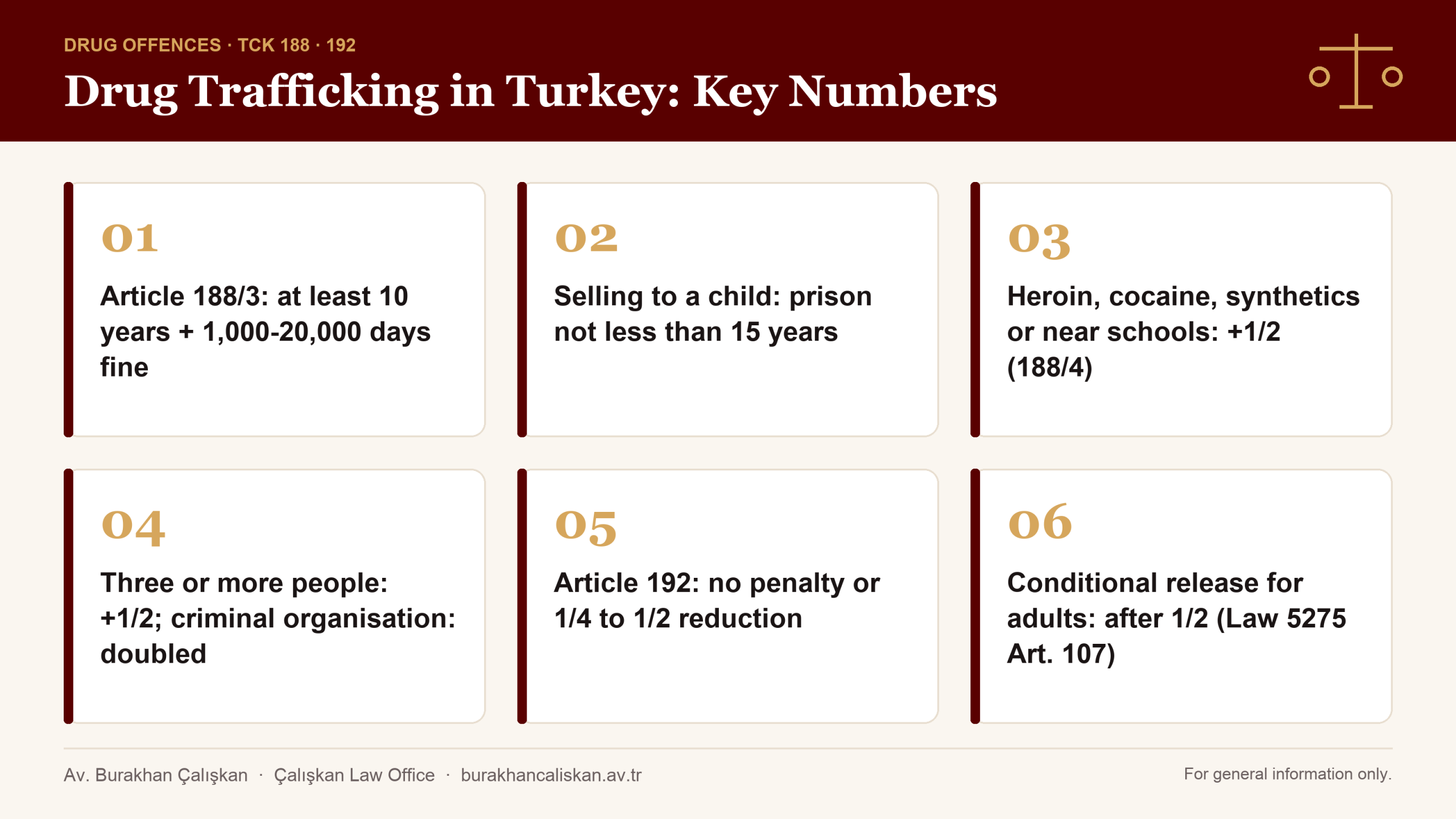
The sentence for drug trafficking in Turkey starts at 10 years in prison under Article 188/3, plus a judicial fine of 1,000 to 20,000 days at 100 to 500 Turkish lira per day (Article 52/2). Selling or giving drugs to a child means at least 15 years.
When is the sentence increased under Articles 188/4 and 188/5?
Drug trafficking sentences in Turkey are increased by one half under Article 188/4 when the substance is heroin, cocaine, morphine, base morphine or a listed synthetic drug, or when the dealing takes place within 200 metres of schools and similar buildings. Article 188/5 adds half for three or more offenders and doubles the penalty for organised crime.
Law No. 7445 (Official Gazette, 5 April 2023) added synthetic cathinones, synthetic opioids and amphetamine and its derivatives to the list in Article 188/4-a, so most methamphetamine and ecstasy cases now carry the increase.
A defendant is convicted of selling methamphetamine (188/3 + 188/4-a). The 10-year minimum plus one half gives 15 years. A discretionary reduction of up to one sixth (Article 62) gives 12 years and 6 months. Conditional release for an adult becomes possible after half, about 6 years and 3 months, with good conduct (Law No. 5275, Article 107/2).
How do Turkish courts tell trafficking from personal use?
Turkish courts decide whether drugs were held for trafficking or for personal use by weighing several factors together: any act of selling or handing over, where and how the drugs were stored, identical small packets, a precision scale and packaging material, the variety of drugs, and the quantity compared with personal-use levels.
The Court of Cassation applies these criteria case by case.
Partly packaged cannabis and 12 pregabalin capsules were found at the defendant’s home, woodshed and car. With no evidence of sale and a quantity within personal-use limits, a trafficking conviction was a wrong characterisation; the judgment was reversed and his release ordered.
A precision scale is the most common piece of side evidence, but it is not decisive alone.
Cannabis, a scale with drug residue, scissors and foil were found in a flat. The amount was within personal-use limits, the defendant consistently claimed personal use, and the search witnesses contradicted the police report. He should have been acquitted of trafficking.
Identical packets and several different drugs held together usually point the other way. Our article on scales and packaging as evidence (in Turkish) covers these situations.
If the evidence points to use rather than sale, see drug possession for personal use in Turkey (Article 191).
What evidence is used: phones, HTS records and surveillance?
Evidence in Turkish drug trafficking cases usually combines the seizure report, the laboratory report on net weight and purity, phone examinations, call and signal records (HTS), physical surveillance and buyer statements. Messages about prices, quantities or meeting points are often treated as the link between possession and sale.
For Article 188, a judge may order phone interception for up to two months plus one month under Article 135 of the Code of Criminal Procedure (CMK), and technical surveillance outside the home for up to three weeks plus one week under Article 140. Buyer statements need corroboration, since a buyer who names a seller may avoid punishment under Article 192/2.
Was the search lawful?
Under CMK Article 119, a home, workplace or closed private area may be searched only on a judge’s decision or, in urgent cases, a prosecutor’s written order; without a prosecutor present, two neighbours or local council members must attend (Code of Criminal Procedure (Turkish)). Missing orders or witnesses are common defence points.
Can police use undercover officers and test purchases?
Police in Turkey may use undercover investigators in drug trafficking cases under CMK Article 139, which expressly covers Article 188. A judge must authorise it, based on strong suspicion and only where evidence cannot be obtained another way.
The limit is provocation: an officer may record a crime that would happen anyway, but may not create one.
Undercover officers approached the defendant and asked whether he had drugs; he sold them methamphetamine. The chamber held that the officers went beyond passive observation and acted as provocateurs, so the evidence could not be used and the defendant should have been acquitted.
The defendant had opened a Telegram channel offering drugs and sold to officers who answered it. Because he made the first offer, there was no provocation and the conviction under Articles 188/3 and 188/4-a was upheld.
The key question in the purchase report is therefore who initiated contact.
Can cooperation reduce the sentence under Article 192?
Cooperation can remove or reduce the sentence for drug trafficking under Article 192 of the Turkish Penal Code, known as effective repentance (etkin pişmanlık). Reporting accomplices and drug locations before the authorities know, leading to arrests or a seizure, means no penalty.
After discovery, voluntary help in revealing the crime and catching the others reduces the sentence by one quarter to one half (Article 192/3). Naming a supplier who cannot be identified usually does not qualify.
How do detention, trial and appeal work in trafficking cases?
Drug trafficking is a catalogue offence under CMK Article 100/3, so a ground for pre-trial detention (tutuklama) may be presumed where strong suspicion rests on concrete evidence. After police custody (gözaltı), a criminal judgeship of peace (sulh ceza hâkimliği) decides between detention and release under judicial control.
Cases are heard by the assize court (ağır ceza mahkemesi). Detention may last up to two years, extendable to five in total (CMK Article 102). Appeals go to the regional court of appeal (istinaf) and the Court of Cassation, each within two weeks of notification. Families can start with our guide for families of people arrested in Turkey.
Each stage of the proceedings is set out in how a criminal case works in Turkey: from police custody to the Court of Cassation.
How much time is served, and what happens to foreign nationals?
An adult convicted of drug trafficking in Turkey is generally eligible for conditional release (koşullu salıverilme) after serving half of the sentence with good conduct, under Article 107/2 of Law No. 5275. Two thirds apply to children convicted under Article 188 and to offences within a criminal organisation (Article 107/4).
A sentenced foreigner is reported to the Ministry of Interior for deportation review (TCK Article 59), and Article 54/1-a of Law No. 6458 makes such persons subject to a deportation decision. Under Article 32 of Law No. 6706, a foreign prisoner may ask to serve the rest at home once the judgment is final, with consent and at least six months remaining.
Common mistakes in drug trafficking cases
- “It was only for friends”: giving drugs to others is trafficking under 188/3, even without payment.
- Changing the account at every stage: consistency matters.
- Not checking the search and undercover reports: they often decide the case.
- Ignoring the laboratory report: net weight and the exact substance decide both personal use and the 188/4 increase.
See also the drug offences information centre (in Turkish), the Article 188 guide (in Turkish), arrested for drugs at Istanbul Airport and more English guides under Criminal Law in Turkey.
Frequently Asked Questions
What is the minimum sentence for drug dealing in Turkey?
At least 10 years in prison and a 1,000 to 20,000-day judicial fine under Article 188/3 of the Turkish Penal Code. Selling to a child raises the minimum to 15 years; heroin, cocaine or synthetic drugs add one half (Article 188/4).
Is a precision scale enough for a trafficking conviction?
Not on its own. A scale and packaging are important signs, but the Court of Cassation has reversed trafficking convictions where the amount stayed within personal-use limits and the scale evidence was inconsistent.
How much drug counts as personal use in Turkey?
There is no fixed legal threshold. Courts weigh the type, quantity and purity of the drug, how it was stored and any evidence of sale, using Forensic Medicine Institute opinions on daily doses as a guide.
Can a conviction rely on a sale to an undercover officer?
It depends on who started the deal. Where officers approached and asked to buy, the 10th Criminal Chamber excluded the evidence as provocation; where the defendant advertised drugs first, the 8th Criminal Chamber upheld the conviction.
How much of a trafficking sentence is served in prison?
An adult is generally eligible for conditional release after serving half with good conduct (Law No. 5275, Article 107/2). The rate is two thirds for organised crime and for children convicted under Article 188.
Will a foreigner convicted of drug trafficking be deported?
The case is reported to the Ministry of Interior (TCK Article 59), and Article 54/1-a of Law No. 6458 makes such foreigners subject to deportation. Prisoner transfer under Article 32 of Law No. 6706 is a separate route.
The evidence can change the charge by years. To get information about your case, you can call or send a WhatsApp message.
About the Author
Av. Burakhan Çalışkan is a lawyer at Çalışkan Hukuk Bürosu in Istanbul, working in criminal law with a focus on drug offences under Articles 188, 191 and 192 of the Turkish Penal Code. His work includes trafficking and possession files, search and undercover-purchase challenges, detention reviews, appeals and deportation questions for foreign nationals. See also criminal defence for foreigners in Istanbul.
Legal Disclaimer: This article has been prepared for general information purposes only and is based on current legislation and established legal practice. The assessments it contains are general explanations that may differ depending on the specific circumstances of each case; they do not constitute legal advice in any way and do not create a lawyer-client relationship. As legislation and case law may change over time, it is recommended that you consult a qualified lawyer before taking any step regarding a specific legal problem.