Short answer: Yes. In Turkey, buying, accepting or possessing drugs for personal use, and using drugs, is a crime under Article 191 of the Turkish Penal Code (TCK), punishable by two to five years in prison. In a first case the prosecutor must defer prosecution for five years and order at least one year of probation; a new offence during that time leads to a trial.
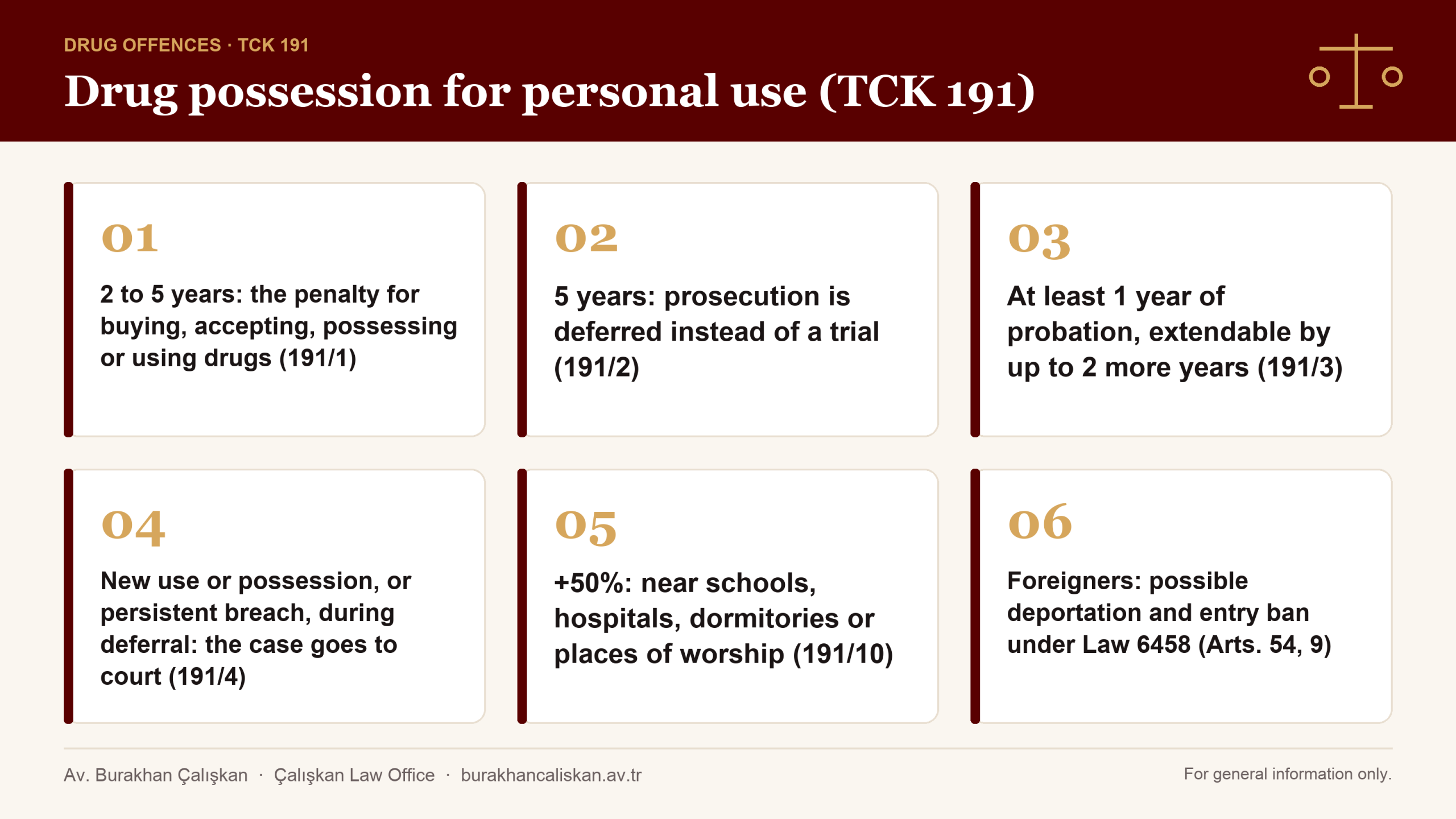
- Buying, accepting, possessing or using drugs for personal use is a crime under Article 191/1, punishable by two to five years.
- A first investigation ends with a mandatory five-year deferral of prosecution and at least one year of probation, not a trial.
- New use or possession during the five years, or persistent breach of probation, sends the case to court.
- For a foreigner, even an investigation without conviction can lead to deportation and an entry ban under Law No. 6458.
Many tourists, students and foreign residents assume a small amount of cannabis is tolerated in Turkey, as in some European countries. It is not. This guide explains drug possession for personal use in Turkey: what Article 191 punishes, how courts separate use from dealing, how the five-year deferral works and what it means for a foreigner’s stay.
The objection period is two weeks. To get information about your case, you can call or send a WhatsApp message.
Is drug possession for personal use a crime in Turkey?
Drug possession for personal use is a crime in Turkey under TCK Article 191/1, which covers four acts: buying, accepting and possessing drugs in order to use them, and using drugs. The offence applies to everyone in Turkey, including tourists, because Turkish law applies to offences committed on Turkish territory (TCK Article 8).
“Any person who buys, accepts or possesses narcotic or stimulant substances for the purpose of using them, or who uses narcotic or stimulant substances, shall be punished with imprisonment from two to five years.” (TCK Article 191/1, unofficial translation)
Cannabis, cocaine, ecstasy, methamphetamine and synthetic cannabinoids are all covered when held for one’s own use. See the Turkish Penal Code (Turkish).
What penalty does Article 191 carry?
Article 191 of the Turkish Penal Code carries two to five years of imprisonment, but the law first routes the suspect into a deferral of prosecution instead of a trial. A prison sentence becomes a real question only after a breach during the deferral, or in a later case where deferral is no longer available.
The Article 191/10 increase applies within 200 metres of such buildings. As an illustration: the minimum two years, reduced by the discretionary one-sixth of TCK Article 62, gives 1 year 8 months, the sentence fixed in the 2025 judgment discussed below.
How do courts decide between personal use and drug dealing?
Turkish courts decide between personal use and drug dealing by looking at the whole file, not at weight alone. The Court of Cassation (Yargıtay) asks whether the person sold, handed over or offered drugs, where and how they were kept, what type and amount was found, and whether a medical report confirms that the person uses drugs.
The difference is decisive: dealing under TCK Article 188/3 carries at least ten years. Equal small packets, a precision scale, packaging material, several different drugs or hidden storage point towards dealing; one piece kept at home and a positive urine test point towards personal use. See our page on precision scales and packaging as evidence (in Turkish).
The Assembly repeated four criteria: selling or supplying conduct, place and manner of possession, type and quantity, and medical proof of use. The net 78 grams of cannabis was within use limits, in one piece, with no scale or packaging found; applying the rule that doubt benefits the accused, the majority held it was possession for personal use, not trafficking.
Citing Forensic Medicine Institute opinions that cannabis users may consume 1 to 1.5 grams up to three times a day and keep several months’ supply, the Chamber quashed a 15-year trafficking sentence: there was no tip-off of sales and blood and urine tests showed the defendant used the same synthetic cannabinoid.
Travellers caught at the border face a different question, import, which is covered in our guide to drug smuggling charges in Turkey (Article 188/1).
Is using drugs, or a positive drug test, a crime on its own?
Using drugs is itself a crime in Turkey. Since Law No. 6545 amended TCK Article 191 in 2014, the provision punishes “a person who uses” narcotic or stimulant substances, not only one who buys or possesses them. A positive blood or urine test can therefore open an investigation even if no drugs are found.
A test shows that a substance is in the body, not when or where it was taken. Because Turkish law applies to offences committed in Turkey (TCK Article 8), the arrival date and detection window can matter for a recently arrived traveller; this is an evidence question, not a guaranteed defence.
What happens when the charge is dealing rather than use is covered in drug trafficking charges in Turkey (Article 188/3).
How does the five-year deferral of prosecution work?
The deferral of prosecution (kamu davasının açılmasının ertelenmesi) is a decision by which the public prosecutor postpones filing a criminal case for five years. Under TCK Article 191/2 it is mandatory in a first Article 191 investigation, without the general conditions of Article 171 of the Code of Criminal Procedure (CMK).
FROM POLICE STOP TO CLOSURE OF THE FILE
Probation (denetimli serbestlik) is run by the local probation office. Its letters are in Turkish, so a foreign national should keep an address and phone number on file that actually reach them. Separately, a user who asks the authorities or a health institution for treatment before any investigation starts is not punished at all (TCK Article 192/4).
The wider procedure, including objections and appeals, is explained in how a criminal case works in Turkey.
What happens if you are caught again during the five years?
A person caught again during the five-year deferral is prosecuted for the original offence. Under TCK Article 191/4, new buying, accepting, possessing or using of drugs, or persistent refusal to follow probation or treatment, leads the prosecutor to file a case. Under Article 191/5, the new act is treated as the breach and not as a separate offence.
A suspect who had completed probation was caught again in 2022, within a deferral ordered in 2020. The Chamber held that the second act was only the breach under Article 191/5, not a further offence, and reduced the sentence from 2 years 1 month to 1 year 8 months.
Under Article 191/6, once a case has been filed after a breach, a later Article 191 investigation cannot be deferred again.
Are CBD, cannabis products or prescription medicines treated differently?
CBD oils, vapes and edibles are not automatically legal in Turkey. What counts is the laboratory report: if it finds a controlled substance such as THC or a synthetic cannabinoid, the product is treated like any other drug under Article 191, whatever a foreign label says.
For prescribed medicines, keep strong painkillers, ADHD medication or sedatives in original packaging with the prescription and a doctor’s letter, and check current rules with the Turkish consulate before travelling.
Can a foreigner be deported or banned from entering Turkey?
A foreign national investigated under Article 191 can face deportation even without a conviction. Law No. 6458 on Foreigners and International Protection allows the governorate to issue a deportation decision against foreigners considered a threat to public order, public security or public health (Article 54/1-d), and Article 9/2 provides that deported foreigners are banned from re-entering Turkey.
An entry ban lasts up to five years, extendable by up to ten more for serious threats (Article 9/3). The deportation decision can be challenged at the administrative court within seven days of notification; meanwhile the person is not removed without consent (Article 53/3). Administrative detention (Article 57) can be challenged before the criminal judgeship of peace. The texts are in the Law on Foreigners and International Protection (Turkish).
After a personal-use drug investigation, an Iranian national received a deportation decision under Article 54/1-d and six months’ administrative detention. The Court found no violation and held that deportation is not a criminal charge, so no conviction is required.
Deportation is not automatic in every Article 191 file. After a prison sentence, TCK Article 59 requires the case to be reported to the Ministry of Interior for deportation assessment.
Common mistakes
- Saying “I share it with friends” to sound harmless; supplying others is the core of a dealing charge.
- Ignoring probation letters after returning home.
- Assuming one year of probation ends the case, while the five-year deferral still runs.
- Missing the seven-day deadline against a deportation decision.
- Bringing CBD products from abroad without checking what they contain.
If the arrest happened at the airport, see our guide on arrested for drugs at Istanbul Airport: the first 48 hours. More guides: Criminal Law in Turkey and criminal defence for foreigners in Istanbul.
Frequently Asked Questions
Will a deferral of prosecution appear on my criminal record?
No. A deferral is not a conviction. Under CMK Article 171/5, applied through TCK Article 191/9, it is kept in a separate system that only prosecutors, judges and courts may consult in connection with an investigation or trial.
Is smoking cannabis once at a party enough for a case?
It can be. Article 191/1 punishes a person who uses drugs, not only one who possesses them. A single proven use, for example through a blood or urine test, can open an investigation, which in a first case normally ends with the five-year deferral.
How many grams count as personal use in Turkey?
There is no statutory gram limit. Courts weigh quantity together with packaging, storage, the variety of substances and medical evidence of use. For cannabis, judgments cite forensic opinions that a user may consume 1 to 1.5 grams up to three times a day.
Can I object to the deferral decision?
Yes. The suspect may object before the criminal judgeship of peace within two weeks of notification, as the Court of Cassation noted in its 2025 judgment. This matters where the evidence or the lawfulness of the search is disputed.
Can a tourist be deported without being convicted?
It can happen. Deportation is an administrative decision of the governorate under Law No. 6458 Article 54/1-d and does not require a conviction. It can be challenged at the administrative court within seven days of notification.
Can I travel home while the deferral is running?
The deferral itself does not create a travel ban. However, probation requires attendance and tests at least twice a year, and persistent non-compliance can lead to prosecution. A judge may separately ban leaving Turkey under CMK Article 109/3-a.
The evidence, the deferral and the immigration consequences can be assessed together. To get information about your case, you can call or send a WhatsApp message.
About the Author
Av. Burakhan Çalışkan is a lawyer at Çalışkan Hukuk Bürosu in Kartal, Istanbul, working in criminal law. His practice includes drug offence files under TCK Articles 188 and 191, deferral and probation procedures and the line between personal use and trafficking, including files of foreign nationals facing deportation. This guide relies on the current TCK, CMK and Law No. 6458 and on fully read judgments.
Legal disclaimer: This article has been prepared for general information purposes only, based on current legislation and established legal practice. The assessments it contains are general explanations that may vary according to the specific circumstances of each case; they do not constitute legal advice and do not create a lawyer-client relationship. As legislation and case law may change over time, it is recommended that you consult a qualified lawyer before taking any step regarding a specific legal problem.