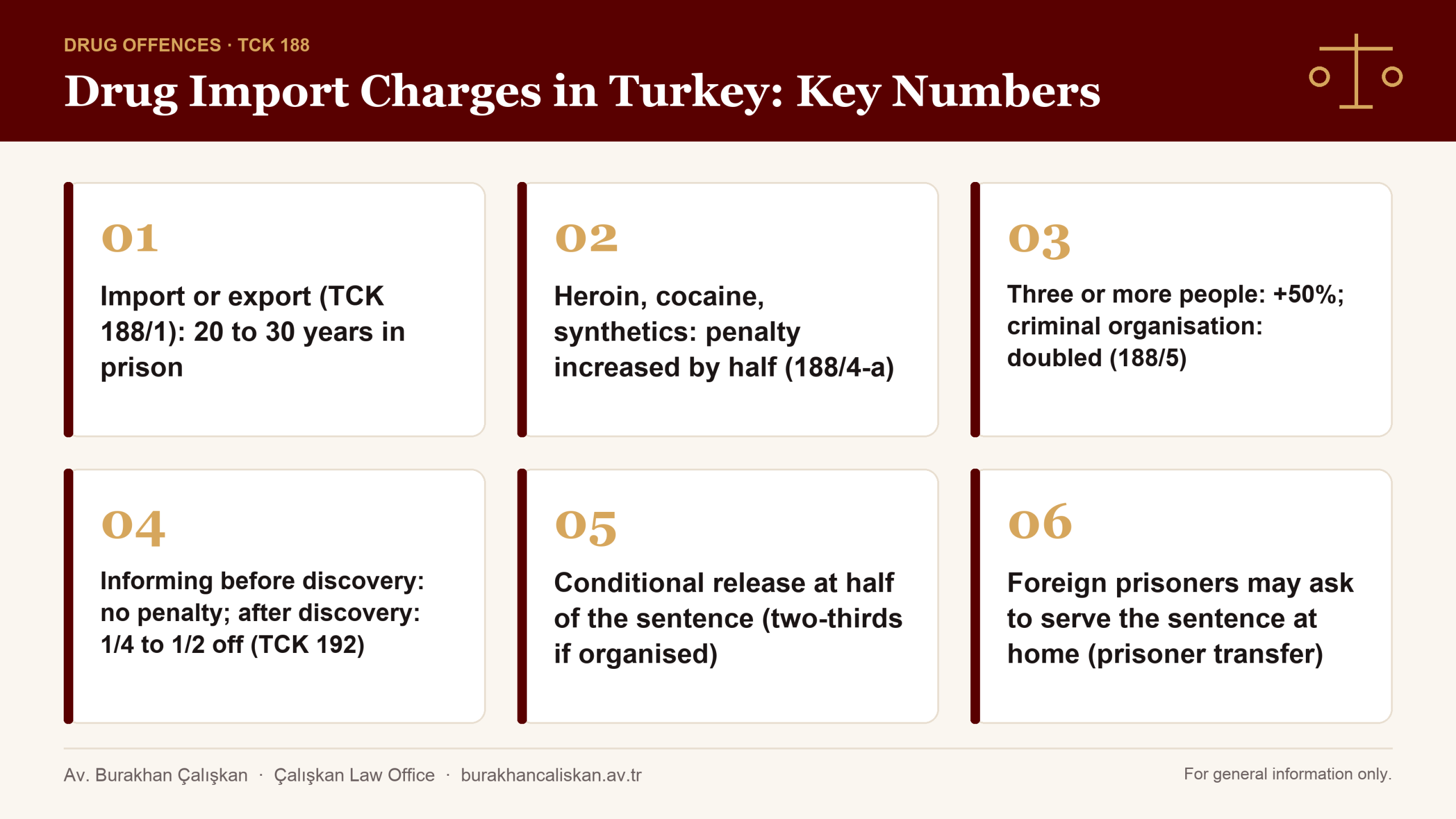
Short answer: Bringing drugs into Turkey or taking them out without a licence is punished under Article 188/1 of the Turkish Penal Code (TCK) with 20 to 30 years in prison and a judicial fine of 2,000 to 20,000 days. For heroin, cocaine and synthetic drugs the penalty is increased by half. Foreigners and Turkish citizens face the same rules.
- Import and export (188/1) carry a heavier range than trafficking inside Turkey (188/3), which starts at 10 years.
- Transit passengers have been convicted of trafficking under 188/3 in the rulings reviewed here.
- “I did not know what was in the bag” is a defence in law, but courts test it against concealment, quantity and travel evidence.
- A foreign prisoner may ask to serve the sentence at home and is usually referred for deportation afterwards.
Drug smuggling charges in Turkey usually begin at an airport or land border. Below: how Article 188/1 works, how the sentence is calculated, which defences courts examine, and what detention, prison time, transfer and deportation mean for a foreigner.
Statements given through an interpreter stay in the file for the whole trial. To get information about the case, you can call or send a WhatsApp message.
What does Article 188/1 of the Turkish Penal Code punish?
Article 188/1 of the Turkish Penal Code punishes anyone who manufactures, imports or exports narcotic or stimulant substances without a licence. Drug import is the offence of bringing such substances across the Turkish border; export is taking them out. Both carry 20 to 30 years in prison and a judicial fine.
The article reads: “Any person who manufactures, imports or exports narcotic or stimulant substances without a licence or in breach of a licence shall be sentenced to imprisonment from twenty to thirty years and a judicial fine from two thousand to twenty thousand days.” (unofficial translation; see the Turkish Penal Code (Turkish)). Each fine day is set between 100 and 500 Turkish lira (Article 52).
Import or trafficking: which charge applies to transit passengers?
Whether a drug case is charged as import under Article 188/1 or trafficking under Article 188/3 depends on whether the substance actually entered Turkey. Trafficking covers selling, transporting, storing and possessing drugs for others inside the country, with at least 10 years in prison, half the import minimum.
In the judgment of the Court of Cassation (Yargıtay) 10th Criminal Chamber of 07.11.2023, E. 2022/4825, K. 2023/9542, two passengers flying from Panama to Johannesburg via Istanbul were caught in the transit area with cocaine hidden in their suitcases. Noting that they had no formal entry into Turkey, the trial court convicted them of trafficking under 188/3 and 188/4-a with 17 years and 6 months, and the conviction was upheld.
The 8th Criminal Chamber followed the same line on 08.06.2026, E. 2025/8851, K. 2026/7877: an Iran-to-London transit passenger with opium gum hidden in his suitcase received 15 years for trafficking. Transit lowers the range; it does not prevent conviction.
How is the sentence calculated under Articles 188/4 and 188/5?
The sentence for drug import in Turkey is built in steps under Article 61 of the Turkish Penal Code. The judge fixes a basic sentence between 20 and 30 years based on quantity, purity and concealment, applies increases under 188/4 and 188/5, then reductions. A fixed-term result cannot exceed 30 years.
- 188/4-a: heroin, cocaine, morphine, base morphine, synthetic cannabinoids, cathinones, opioids or amphetamines: increased by half.
- 188/5: three or more people acting together: increased by half; within a criminal organisation: doubled.
- Article 62: discretionary mitigation for background, conduct and remorse: up to one sixth off.
Quantity and purity come from the forensic laboratory report; weighing, sampling and chain of custody therefore deserve close review.
A traveller acting alone is convicted of importing cocaine. Basic sentence: 20 years and 2,000 days. Cocaine increase (188/4-a): 30 years and 3,000 days. Article 62 (one sixth off): 25 years and 2,500 days; at 100 lira per day the fine is 250,000 lira.
Can a person say they did not know the drugs were in the bag?
Lack of knowledge is a valid defence under Turkish law. Article 21 of the Turkish Penal Code requires intent, meaning the offence must be committed knowingly and willingly, and Article 30 states that a person unaware of the material elements of the offence does not act with intent. The question is one of evidence.
Courts test the defence against concealment, quantity, ticket history, phone records and consistency. In the 8th Criminal Chamber judgment of 01.10.2024, E. 2024/16202, K. 2024/7235, a traveller arriving from Brazil via Doha said he believed car electronics had been sewn into his suitcase lining; nearly three kilograms of cocaine were hidden in its side walls.
The courts held that he was obliged to check what was placed in his suitcase and that his claim of ignorance did not fit “the ordinary course of life”; the offence was complete once the drugs entered Turkey. The 27 years and 6 months sentence was upheld.
Swallowed capsules are treated like luggage. An internal body examination requires a judge’s order (or a prosecutor’s order approved within 24 hours), a doctor and no health risk (Code of Criminal Procedure, CMK, Article 75).
Selling or supplying drugs inside Turkey is explained in drug trafficking charges in Turkey (Article 188/3).
What if the drugs were for personal use or prescription medicine?
Drugs carried for personal use should not be charged as import. Import requires a purpose other than personal use, so a small quantity consistent with the traveller’s own consumption points to Article 191, which carries two to five years and normally begins with a five-year deferral of prosecution under probation.
In the 8th Criminal Chamber judgment of 29.06.2026, E. 2026/5811, K. 2026/9311, a traveller entering from Iran had methadone tablets that he said he used to quit drugs. Methadone was found in his blood, the quantity was within the use limit and his phone showed no trade, so the import conviction was quashed and his release ordered.
See our guide to drug possession for personal use in Turkey (Article 191).
Can cooperation with the authorities reduce the sentence?
Effective repentance (etkin pişmanlık) under Article 192 of the Turkish Penal Code can remove or reduce the penalty in drug import cases. A participant who reveals accomplices and hiding places before the authorities learn of the offence receives no penalty, provided the information leads to arrests or the seizure of drugs.
After discovery, voluntary help in uncovering the offence and catching the perpetrators reduces the sentence by one quarter to one half (Article 192/3). In the 2024/16202 file it was refused because the defendant denied the act and his statements did not help the police.
Which court hears the case and how long can detention last?
Drug import cases are heard by the assize court (ağır ceza mahkemesi), which handles offences punishable by more than ten years. After police custody (gözaltı), a criminal judgeship of peace (sulh ceza hâkimliği) decides whether the suspect is detained (tutuklama) or released under judicial control.
Article 188 is a catalogue offence under CMK Article 100/3, so a ground for detention may be presumed when strong suspicion exists. Detention may last up to two years, extendable by up to three more years, and up to one year during the investigation (Article 102). An interpreter is provided (Article 202), and judgments can be appealed (istinaf, then Yargıtay) within two weeks of notification.
What happens between the airport arrest and the first court hearing is explained step by step in arrested for drugs at Istanbul Airport: the first 48 hours.
How much of the sentence is actually served in prison?
Conditional release (koşullu salıverilme) for an adult convicted of drug import is generally available after half of the sentence has been served with good conduct, under Article 107/2 of the Execution of Sentences Law No. 5275. The two-thirds rate in that paragraph covers children convicted under Article 188, not adults.
If the offence was committed within a criminal organisation, two thirds must be served (Article 107/4). In the worked example, 25 years means about 12 years and 6 months before conditional release; under Article 105/A, the last year may be served on probation from an open prison if conditions are met. See also the drug offences information centre (in Turkish).
Can a foreigner serve the sentence at home, and will they be deported?
A foreign national convicted in Turkey can ask to serve the rest of the sentence at home through prisoner transfer under Article 32 of Law No. 6706 on International Judicial Cooperation in Criminal Matters. The judgment must be final, the prisoner must consent and at least six months must normally remain.
No other case may be pending in Turkey, and the judicial fine must be paid or its unpaid part is converted into imprisonment (Article 32/4). The Minister of Justice decides once the foreign state consents (Law No. 6706 (Turkish); see also prisoner transfer (in Turkish)).
Deportation is separate. Under Article 59 of the Turkish Penal Code, a sentenced foreigner is reported to the Ministry of Interior for deportation review; Article 54/1-a of Law No. 6458 makes such persons subject to deportation, and Article 9 allows an entry ban of up to five years, extendable for serious threats.
Practical steps for relatives abroad (lawyer, power of attorney, prison visits) are covered in my family member was arrested in Turkey.
Common mistakes in drug import cases
- Signing statements without understanding the translation: inconsistencies are cited when courts reject the lack-of-knowledge defence.
- Ignoring the laboratory report: net weight and purity drive the sentence.
- Assuming transit means no Turkish jurisdiction: transit passengers have been convicted under 188/3.
- Missing the two-week appeal deadline: the judgment then becomes final.
- Leaving transfer planning to the end: unpaid fines and costs delay a transfer request.
For an overview of criminal cases for foreign nationals, see Istanbul criminal lawyer services in English and the Turkish guide to the drug trafficking offence under Article 188 (in Turkish). More English guides are under Criminal Law in Turkey.
Frequently Asked Questions
What is the minimum sentence for drug smuggling in Turkey?
The minimum is 20 years in prison and a judicial fine of 2,000 days under Article 188/1 of the Turkish Penal Code. For heroin, cocaine and synthetic drugs it rises by half, to 30 years before reductions.
Is a foreigner sentenced more harshly than a Turkish citizen?
No. Article 188 applies equally to citizens and foreigners, and nationality is not an aggravating factor. The differences lie in detention risk, interpreters, deportation and prisoner transfer.
Can someone caught in transit at Istanbul Airport be convicted?
Yes. In the Court of Cassation rulings reviewed here, transit passengers without formal entry into Turkey were convicted of trafficking under Article 188/3 instead of import. That offence starts at 10 years.
Does cooperating with the police reduce the sentence?
It can. Under Article 192, information given before the authorities learn of the offence that leads to arrests or a drug seizure means no penalty. Help given after discovery reduces the sentence by one quarter to one half.
How long can pre-trial detention last?
Up to two years in assize court cases, extendable by up to three more years, and up to one year during the investigation (CMK Article 102).
Can a foreign prisoner serve the sentence in their home country?
Yes, if the judgment is final, the prisoner consents, at least six months remain and the judicial fine is paid or converted (Law No. 6706, Article 32). The Minister of Justice decides after the foreign state agrees.
Import, transit trafficking or personal use: the charge changes the sentence by many years. To get information about your case, you can call or send a WhatsApp message.
About the Author
Av. Burakhan Çalışkan is a lawyer at Çalışkan Hukuk Bürosu in Istanbul, working in criminal law with a focus on drug offences under Articles 188 and 191 of the Turkish Penal Code. His work includes airport and border seizure files, detention reviews, laboratory report challenges, appeals, sentence execution and prisoner transfer for foreign nationals. Here he explains drug import charges using the current statute and recent Court of Cassation judgments.
Legal Disclaimer: This article has been prepared for general information purposes only and is based on current legislation and established legal practice. The assessments it contains are general explanations that may differ depending on the specific circumstances of each case; they do not constitute legal advice in any way and do not create a lawyer-client relationship. As legislation and case law may change over time, it is recommended that you consult a qualified lawyer before taking any step regarding a specific legal problem.