Short answer: If your family member was arrested in Turkey, first find out whether he or she is in police custody (gözaltı), which lasts 24 hours and at most four days, or has been sent to prison by a judge (tutuklama). Contact your consulate, appoint a Turkish lawyer, who can see the detainee without a power of attorney, and never pay callers claiming to be the police.
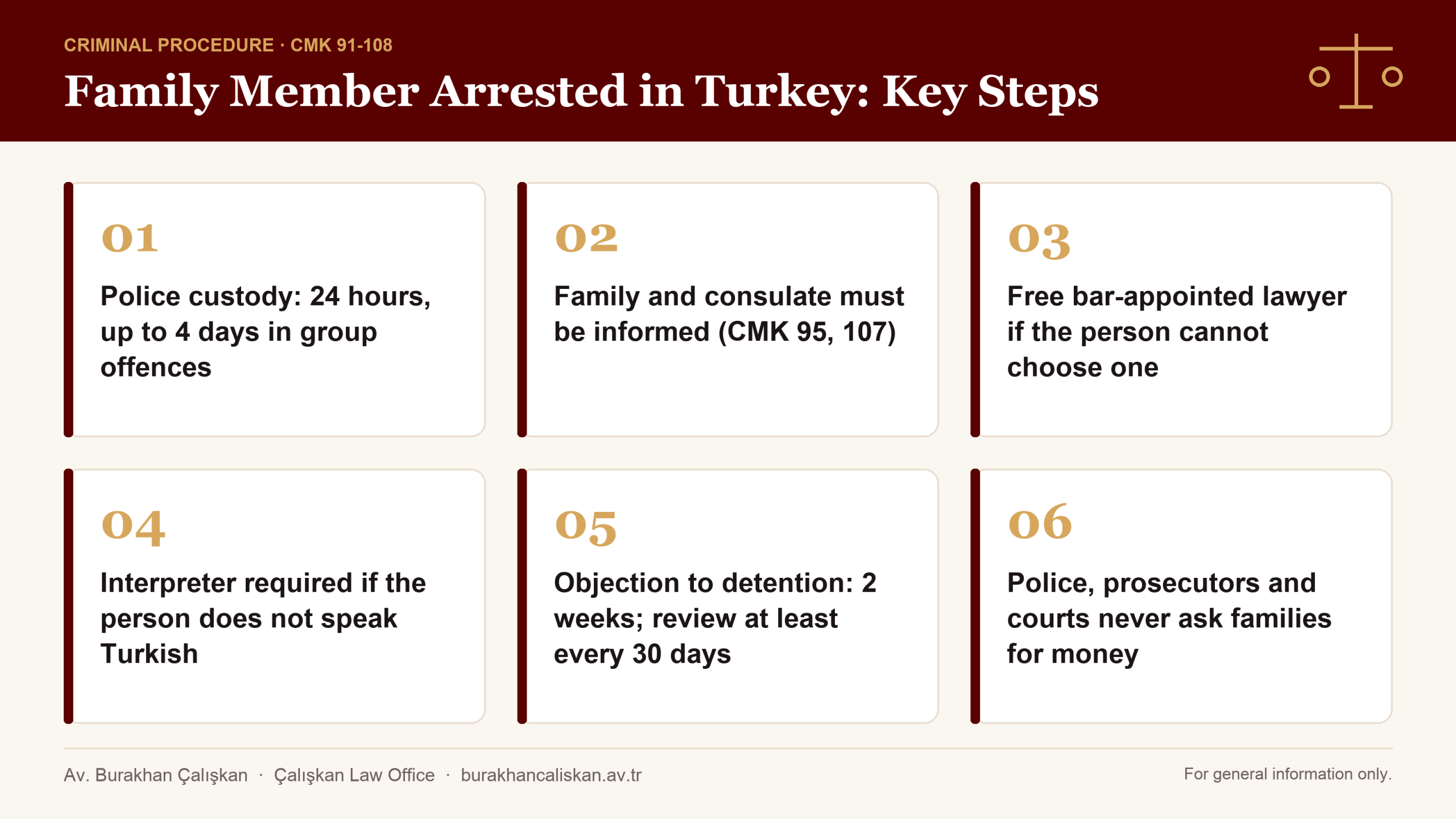
- Police custody (gözaltı) lasts 24 hours, and at most four days in offences committed jointly.
- A relative and, unless the detainee objects in writing, the consulate must be informed (CMK m. 95, 107).
- A lawyer can see the detainee without a power of attorney; otherwise the bar appoints one.
- Pre-trial detention (tutuklama) can be challenged within two weeks.
- No police officer, prosecutor or judge asks families for money.
When a family member is arrested in Turkey, relatives abroad face a language barrier and little information. This guide explains, step by step, what the Turkish Code of Criminal Procedure (Ceza Muhakemesi Kanunu, CMK) and the Law on the Execution of Sentences (No. 5275) require, and what the family can do from abroad.
The two-week objection period does not wait for the family. To get information about your case, you can call or send a WhatsApp message.
What is the difference between police custody and pre-trial detention in Turkey?
Police custody (gözaltı) is a short holding period ordered by the public prosecutor while the police take a statement; pre-trial detention (tutuklama) is a court order that sends the suspect to prison while the case continues. Custody ends within days; detention can last months, so families should first ask which of the two applies.
Custody cannot exceed 24 hours plus transfer time (CMK m. 91/1); in joint offences the prosecutor may add up to three days (m. 91/3). Detention is ordered by the criminal judgeship of peace (sulh ceza hâkimliği) on strong suspicion plus a ground such as flight risk (m. 100, 101). A detailed overview of the detention rules is in our guide to pre-trial detention under CMK 100-108 (in Turkish).
Family members may file the custody challenge themselves: under m. 91/5, the spouse and close blood relatives can ask the judge for immediate release.
How can a family abroad find out where the person is held?
A family abroad can find out where a relative is held through three channels: the call the authorities must make to a relative, the consulate of the detainee’s country, and a Turkish lawyer, who can locate the file through the prosecutor’s office. Turkish law gives both relatives and consulates a right to be told.
“If the person arrested or taken into custody is a foreign national, his or her situation shall be notified to the consulate of the State of which he or she is a national, unless he or she objects in writing.” (CMK m. 95/2, unofficial translation)
CMK m. 107 repeats this duty when detention is ordered. Article 36 of the Vienna Convention on Consular Relations gives the same right. Full Turkish text of the Code: the Legislation Information System (Turkish).
A foreign woman arrested at Istanbul Airport was convicted on an uncertified passport copy. Her relatives, unable to reach her, asked their embassy to trace her; the embassy’s documents showed different identity details. The Plenary Chamber quashed the conviction: a foreign defendant’s identity must be established beyond doubt through official records.
If you cannot reach a relative, tell your embassy and keep copies of his or her identity documents ready.
How do we appoint a lawyer from abroad, and do we need a power of attorney?
A family abroad can appoint a Turkish lawyer before signing any power of attorney, because CMK m. 154/1 allows a suspect to meet a lawyer “without a power of attorney” at any time and in private. The lawyer visits the detainee, who confirms the instruction; the formal power of attorney (vekaletname) follows.
The detainee can sign the power of attorney in prison before a Turkish notary. A Turkish citizen abroad can sign one at a Turkish consulate; a foreign national usually signs before a local notary, obtains an apostille (Hague Convention countries) and adds a sworn Turkish translation. Details are in our guide on following a Turkish case from abroad (in Turkish); appointments are made through konsolosluk.gov.tr.
If no lawyer is chosen, the bar appoints one on request (CMK m. 150/1), and without request where the minimum sentence exceeds five years (m. 150/3). The State pays this lawyer (Law No. 5320 Art. 13).
A defendant facing a minimum of six years told the court he did not want a lawyer and was convicted without one. The Chamber held that CMK m. 150/3 required a lawyer regardless of his wishes, quashed the conviction and stopped execution of the sentence.
Can the family or the lawyer see the case file?
The case file is open to the defence lawyer, not to family members. Under CMK m. 153/1, the lawyer may examine the investigation file and take free copies; after the indictment is accepted, he or she sees the whole file and seized evidence (m. 153/4).
A judge may restrict access for listed offences such as drug trafficking and smuggling (m. 153/2), but statements and expert reports stay open (m. 153/3).
For how drug import charges are assessed and sentenced, see drug smuggling charges in Turkey (Article 188/1).
What rights does a foreign detainee have to an interpreter and a consulate?
A foreign detainee who does not speak enough Turkish has the right to an interpreter at the police, prosecutor and court stages, and the right to have the consulate informed. CMK m. 202 requires the court to appoint an interpreter so that the essential points of the accusation and defence are translated.
Article 6/3-e of the European Convention on Human Rights guarantees the free assistance of an interpreter; only an interpreter chosen separately under m. 202/4 is not paid by the State. Consular officers may visit a foreign prisoner, and the prison must handle such requests without delay (Law No. 5275 m. 84).
A foreign defendant in a drug case gave his police statement with an interpreter but was questioned by the judge and tried without one, without being asked whether he understood Turkish. The Chamber quashed the judgment under ECHR Article 6/3-a and CMK m. 202, but rejected his release request.
Which prison is the person in, and how can we visit, call or send money?
The detention order names the prison, and the lawyer can confirm it in the court system; the person may later be transferred. Visits, calls and letters follow Law No. 5275 rules for prisoners, applied to detainees where compatible (m. 116), but the prosecutor or court may restrict visits and calls (m. 114/2-3).
Contact with a detained family member
See also which prison a sentence is served in (in Turkish) and Law No. 5275 (Turkish).
How can pre-trial detention be challenged or ended?
Pre-trial detention can be challenged by an objection within two weeks of learning of the decision (CMK m. 268/1), by a release request at any stage (m. 104/1), and through periodic reviews at intervals of at most 30 days during the investigation (m. 108/1). An objection against the criminal judgeship of peace goes to the criminal court of first instance (m. 268/3-b).
Instead of detention, the judge can impose judicial control (adli kontrol) under m. 109: a travel ban, reporting or bail. Detention is barred for offences punishable only by fines or by a maximum of two years, except intentional offences against bodily integrity (m. 100/4).
If the arrest happened at the airport on a drug charge, see arrested for drugs at Istanbul Airport: the first 48 hours.
What happens at trial, and can the person attend by video?
The trial begins when the court accepts the prosecutor’s indictment; hearings are public (CMK m. 182/1), so relatives can usually attend. Under m. 196/4, a defendant in Turkey may be questioned or attend hearings by audio-video link (SEGBİS) when the court considers it necessary.
An appeal (istinaf) against the judgment must be lodged within two weeks of service of the reasoned judgment.
For a full map of the proceedings and appeal deadlines, see how a criminal case works in Turkey.
Common mistakes families make
In files involving foreign defendants, these mistakes cost families time or rights most often:
- Waiting for the consulate to appoint a lawyer: consulates do not act as defence counsel.
- Sending a power of attorney without an apostille or Turkish translation, which delays the lawyer’s formal appointment.
- Letting the objection period pass while hoping the next review will release the person.
- Discussing the case on recorded prison phone lines instead of through the lawyer.
How do you recognise a “pay the police” scam call?
A call demanding money to release a relative or “close the file” is a scam. Turkish police, prosecutors and judges never ask families for money by phone, and bail under CMK m. 109 is set by a judge’s written decision. Hang up and verify through your lawyer or consulate.
Frequently Asked Questions
How long can the police hold my relative before a judge sees him?
Police custody lasts 24 hours from the arrest, plus up to 12 hours to reach the nearest judge. In offences committed jointly, the prosecutor can extend it one day at a time by up to three days. The person is then released or brought before a judge.
Will the police call us if our relative is arrested?
One relative, or a person the detainee chooses, must be informed without delay on the prosecutor’s order (CMK m. 95). The consulate of a foreign national is also informed unless he or she objects in writing, so families abroad should contact their consulate.
Can we hire a lawyer from abroad without travelling to Turkey?
Yes. The lawyer can meet the detainee without a power of attorney (CMK m. 154/1), and the detainee can then sign one in prison before a notary. A relative abroad can also sign one at a Turkish consulate or before a local notary with an apostille.
Is the bar-appointed lawyer free?
The family does not pay the bar-appointed lawyer; the Ministry of Justice pays the fee under Law No. 5320 Article 13. The same article counts the fee as a trial cost, so it may later be charged to a convicted defendant.
Can we visit our relative in a Turkish prison?
Yes, unless the prosecutor or court has restricted visits. Spouses and relatives up to the third degree may visit once a week for 30 to 90 minutes after proving the relationship. Confirm the visit day with the prison in advance.
How long can pre-trial detention last in Turkey?
During the investigation, detention cannot exceed six months, or one year for offences tried by the serious crimes court, with longer limits for terrorism and group offences. Overall limits are one year plus six months, or two years extendable by up to three years (CMK m. 102).
Knowing the file stage helps you plan. To get information about your case, you can call or send a WhatsApp message.
About the Author
Av. Burakhan Çalışkan is a criminal defence lawyer based in Istanbul who represents suspects and defendants at the police custody, detention and trial stages, including foreign nationals and Turkish citizens living abroad. His work involves detention objections, interpreter and consular issues, and families following cases from abroad. See the Istanbul criminal lawyer page. Further English articles are listed under Criminal Law in Turkey.
Legal Disclaimer
This article has been prepared for general information purposes only, based on current legislation and established legal practice. The assessments it contains are general explanations that may vary according to the specific circumstances of each case; they do not constitute legal advice in any way and do not create a lawyer-client relationship. As legislation and case law may change over time, it is recommended that you consult a lawyer authorised in the relevant field before taking any step regarding a specific legal problem.