Short answer: A criminal case in Turkey moves from a complaint or arrest to an investigation by the public prosecutor, then either a non-prosecution decision or an indictment. If the court accepts the indictment, hearings follow and end with a verdict. The verdict can be appealed to a regional court of appeal (istinaf) and then to the Court of Cassation (Yargıtay), each within two weeks of service of the reasoned judgment.
- A Turkish criminal case has two stages: the prosecutor’s investigation (soruşturma) and the trial stage (kovuşturma).
- A defendant who cannot follow Turkish is entitled to a court-appointed interpreter.
- Istinaf and temyiz must be filed within two weeks of service of the reasoned judgment (Law No. 7499).
- After Law No. 7589 (2026), HAGB remains available for sentences of two years or less.
This guide maps how a criminal case in Turkey works for foreign defendants and their families: who decides at each stage and which deadlines apply under the Code of Criminal Procedure (CMK) and the Turkish Penal Code (TCK).
Objections and appeals must be filed within two weeks. To get information about your case, you can call or send a WhatsApp message.
What are the main stages of a criminal case in Turkey?
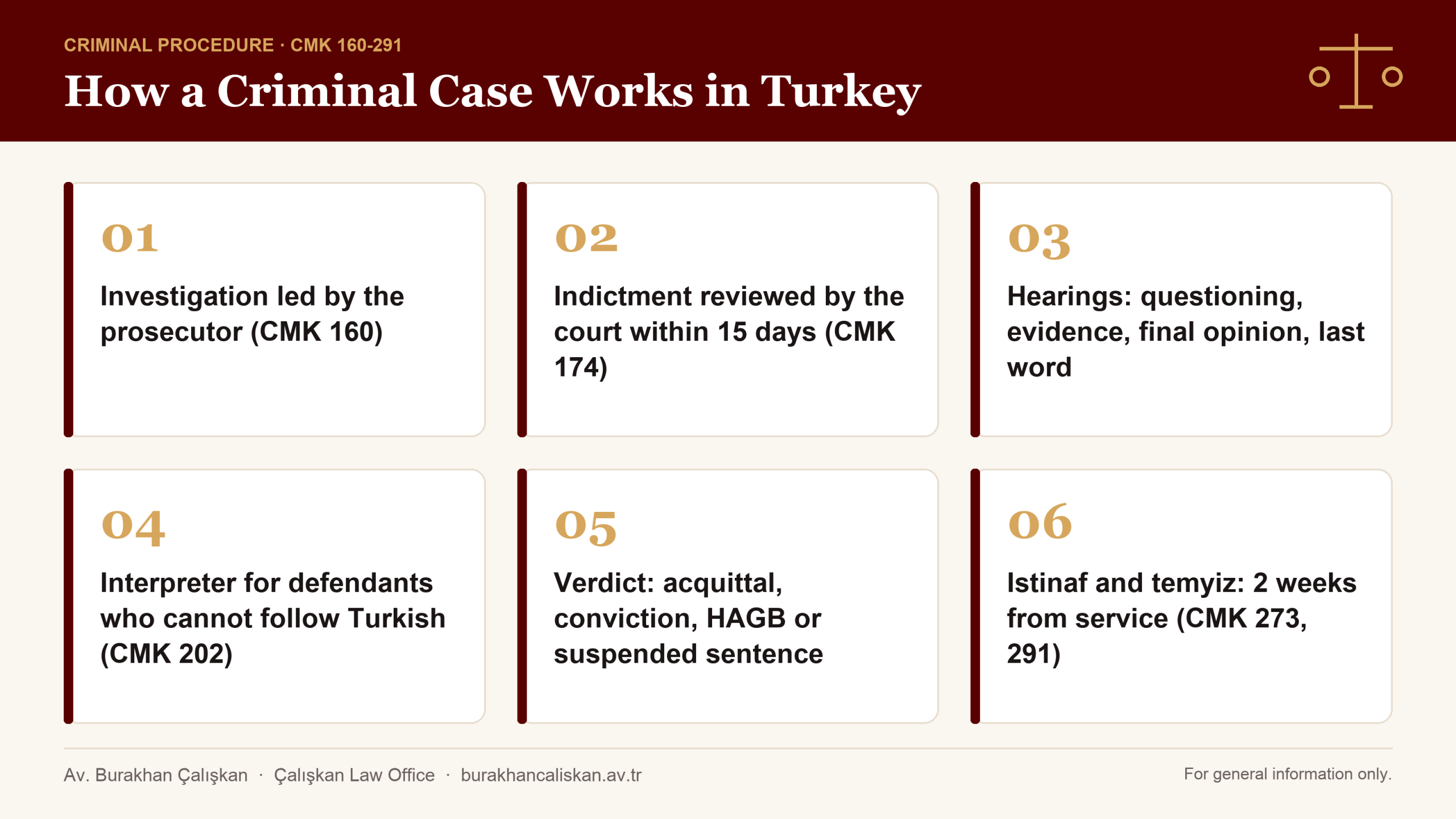
A criminal case in Turkey has two legal stages. The investigation (soruşturma) runs from the moment the authorities learn of a possible offence until a court accepts the indictment; the trial stage (kovuşturma) starts with that acceptance and lasts until the judgment becomes final (CMK Articles 2 and 175).
FROM COMPLAINT TO FINAL JUDGMENT
What happens during the investigation stage?
The investigation in a Turkish criminal case is led by the public prosecutor (Cumhuriyet savcısı), who must examine the facts as soon as he or she learns of a possible offence and collect evidence both for and against the suspect (CMK Article 160).
Police custody (gözaltı) may last 24 hours, or up to four days in collective offences (Article 91). Before any statement, the suspect is told the accusation, the right to a lawyer and the right to remain silent (Article 147), and a foreign suspect’s consulate is informed unless he or she objects in writing (Article 95/2). The criminal judgeship of peace (sulh ceza hâkimliği) may order pre-trial detention (tutuklama) or judicial control; detention can be challenged within two weeks (Articles 101/5 and 268) and is reviewed at least every 30 days (Article 108). Families can read what to do when a family member is arrested in Turkey.
How does the prosecutor decide between non-prosecution and an indictment?
The prosecutor files an indictment (iddianame) when the evidence creates sufficient suspicion that the offence was committed (CMK Article 170/2). If the evidence is insufficient or prosecution is impossible, the prosecutor issues a non-prosecution decision (kovuşturmaya yer olmadığına dair karar), which the victim may challenge within two weeks of service (Articles 172 and 173).
The court has 15 days to review the indictment and may return it for listed defects; if not returned in time, it is deemed accepted (Article 174). Acceptance opens the public case, and the court sets the hearing date (Article 175), a step known in practice as tensip. The indictment is served with a summons at least one week before the hearing (Article 176/4).
What happens at the trial hearings?
Trial hearings in a Turkish criminal court follow a fixed order. The judge reads the decision accepting the indictment, identifies the defendant, explains the accusation and evidence, reminds the defendant of the right to remain silent and then questions him or her (sorgu) if he or she agrees to speak (CMK Article 191).
As a rule, no hearing is held without the defendant (Article 193/1). After witnesses and documents are examined, the prosecutor gives a final opinion on the merits (esas hakkında mütalaa), the parties reply, and the defendant speaks last before the verdict (Article 216/3).
Can a defendant who lives abroad be excused from hearings?
A defendant who has been questioned by the court can be excused from attending further hearings (duruşmadan vareste) at his or her own request, or at the lawyer’s request if authorised (CMK Article 196/1). For a defendant abroad, the court may hold an earlier hearing or question him or her by letters rogatory (istinabe) (Article 196/6).
“The defendant may be questioned by letters rogatory, except for offences carrying a minimum penalty of five years’ imprisonment or more.” (CMK Article 196/2, unofficial translation)
Video-link questioning (SEGBİS) covers only defendants in Turkey (Article 196/4).
A defendant held in prison for another case, never asked whether he wished to be excused, was convicted at a final hearing he could not attend. By majority, the General Assembly held that the right to be present can only be waived expressly and quashed the conviction.
A defendant abroad who had declined to testify at a foreign police station was convicted without his rights being explained and his defence taken. The Chamber held this breached CMK Article 193 and Article 6 of the European Convention on Human Rights.
What rights does a foreign defendant have in a Turkish court?
A foreign defendant who cannot express himself or herself in Turkish has the right to a court-appointed interpreter, who translates the essential points of the prosecution and the defence (CMK Article 202/1). The rule also applies during the investigation (Article 202/3), and a lawyer is appointed without request for offences with a minimum above five years (Article 150/3).
After the indictment is explained and after the prosecutor’s final opinion, the defendant may also give the oral defence in a language he or she prefers, through an interpreter chosen from the official list at his or her own cost (Article 202/4).
In a drug dealing case, a defendant who had testified through an interpreter answered the prosecutor’s final opinion without one. The Chamber found a restriction of the right of defence under Article 6/3-a of the Convention and CMK Article 202 and quashed the judgment.
For how evidence is weighed in drug dealing cases, see drug trafficking charges in Turkey (Article 188/3).
What verdicts can a Turkish criminal court give?
A Turkish criminal court ends the trial with acquittal (beraat), conviction (mahkûmiyet), a decision that no penalty is imposed, a security measure, dismissal or discontinuance of the case (CMK Article 223). With a short sentence, the court may also defer the verdict (HAGB) or suspend the sentence.
HAGB (hükmün açıklanmasının geri bırakılması) requires a sentence of two years or less or a judicial fine, no prior intentional conviction, a belief that the defendant will not reoffend and repaired damage (Article 231/5-6, rewritten by Law No. 7589 in July 2026). Five years of supervision follow; without a new intentional offence, the case is dismissed (Article 231/8, 10). A sentence under HAGB cannot also be suspended (Article 231/7). See our HAGB guide (in Turkish).
How long do you have to appeal to the regional court (istinaf)?
An appeal to the regional court of appeal (bölge adliye mahkemesi), called istinaf, must be filed within two weeks from service of the judgment with its reasons, by petition to the court that gave it or by a statement to the court clerk (CMK Article 273/1). Before Law No. 7499 of 2024 it was seven days from pronouncement.
Sentences of 15 years or more are reviewed automatically (Article 272/1). The regional court may dismiss the appeal, correct, quash or retry the case (Article 280). HAGB decisions are also challenged by istinaf (Article 231/12).
How the five-year deferral works in personal-use drug cases is explained in is drug possession for personal use a crime in Turkey?
When can the case go to the Court of Cassation?
Regional court decisions, other than those quashing and remanding, can be taken to the Court of Cassation (Yargıtay) by temyiz within two weeks of service of the reasoned judgment (CMK Articles 286/1 and 291/1). Many are excluded, for example a decision dismissing the appeal against a prison sentence of five years or less (Article 286/2-a).
The Court of Cassation reviews points of law; it upholds or quashes the judgment (Article 302). The judgment becomes final when no appeal is filed in time or the last remedy is decided, and the prosecutor’s office then enforces it.
Common mistakes foreign defendants and families make
- Leaving Turkey without a reachable address for service, so the reasoned judgment is served without the defendant knowing.
- Counting the appeal period from the hearing instead of from service, or missing it altogether.
- Waiving the interpreter after saying “I understand a little Turkish”.
- Treating HAGB as an acquittal and committing a new intentional offence during supervision.
If the case began at the border, see arrested for drugs at Istanbul Airport. More guides are under Criminal Law in Turkey and on our page on criminal defence in Istanbul. Official texts: CMK (Turkish), TCK (Turkish).
Frequently Asked Questions
How long does a criminal case take in Turkey?
There is no fixed duration. A simple case may end within months; an assize court case with several defendants can take much longer, followed by the appeal stages. For detained defendants, CMK Article 102 caps detention at two years in assize court cases, extendable with reasons up to three years in total.
Can a criminal case continue in Turkey while I live abroad?
Yes. The case does not stop because the defendant has left Turkey. If the offence carries a minimum below five years, the court may question the defendant through letters rogatory (istinabe) and then excuse attendance; a lawyer in Turkey follows the hearings.
Is a lawyer mandatory in a Turkish criminal case?
Only in some cases. A lawyer is appointed without request when the offence carries a minimum of more than five years, or when the suspect is a child or cannot defend himself or herself (CMK Article 150). Otherwise one is appointed on request.
How do I find out the result of a hearing in Turkey?
The verdict is read out at the final hearing; the reasoned judgment is written later and served on the parties. Lawyers follow the file through the national judiciary network (UYAP). The two-week appeal period runs from service of the reasoned judgment.
Does an HAGB decision count as a criminal record?
No. Under CMK Article 231/5, a deferred verdict produces no legal consequence apart from confiscation. It is kept in a special register that only prosecutors and courts can consult. If the five-year supervision passes without a new intentional offence, the case is dismissed.
Can a detained defendant file an appeal from prison?
Yes. Under CMK Article 263, a detained defendant can file a petition or make a statement to the prison director or the court clerk; the deadline is considered met once the statement is recorded and registered.
The file, the hearing minutes and the reasoned judgment show which remedies are still open. To get information about your case, you can call or send a WhatsApp message.
About the Author
Av. Burakhan Çalışkan is a lawyer at Çalışkan Hukuk Bürosu in Kartal, Istanbul, working in criminal law. His practice covers every stage of the Turkish criminal process, from custody and detention hearings to trials, istinaf and appeals to the Court of Cassation, including cases of defendants who live abroad. This guide relies on the current CMK and TCK texts and fully read Court of Cassation judgments.
Legal disclaimer: This article has been prepared for general information purposes only, based on current legislation and established legal practice. The assessments it contains are general explanations that may vary according to the specific circumstances of each case; they do not constitute legal advice and do not create a lawyer-client relationship. As legislation and case law may change over time, it is recommended that you consult a qualified lawyer before taking any step regarding a specific legal problem.