
Short answer: Extradition from Turkey is possible only for foreigners. Under Law No. 6706, a foreign national wanted abroad, often through an Interpol red notice, can be arrested, held provisionally for up to 40 days, and surrendered if a heavy penal court finds the request admissible and the President approves. Turkish citizens, including dual nationals, are not extradited.
- Extradition from Turkey is governed by Law No. 6706 (Articles 10-22) together with the treaty in force with the requesting state.
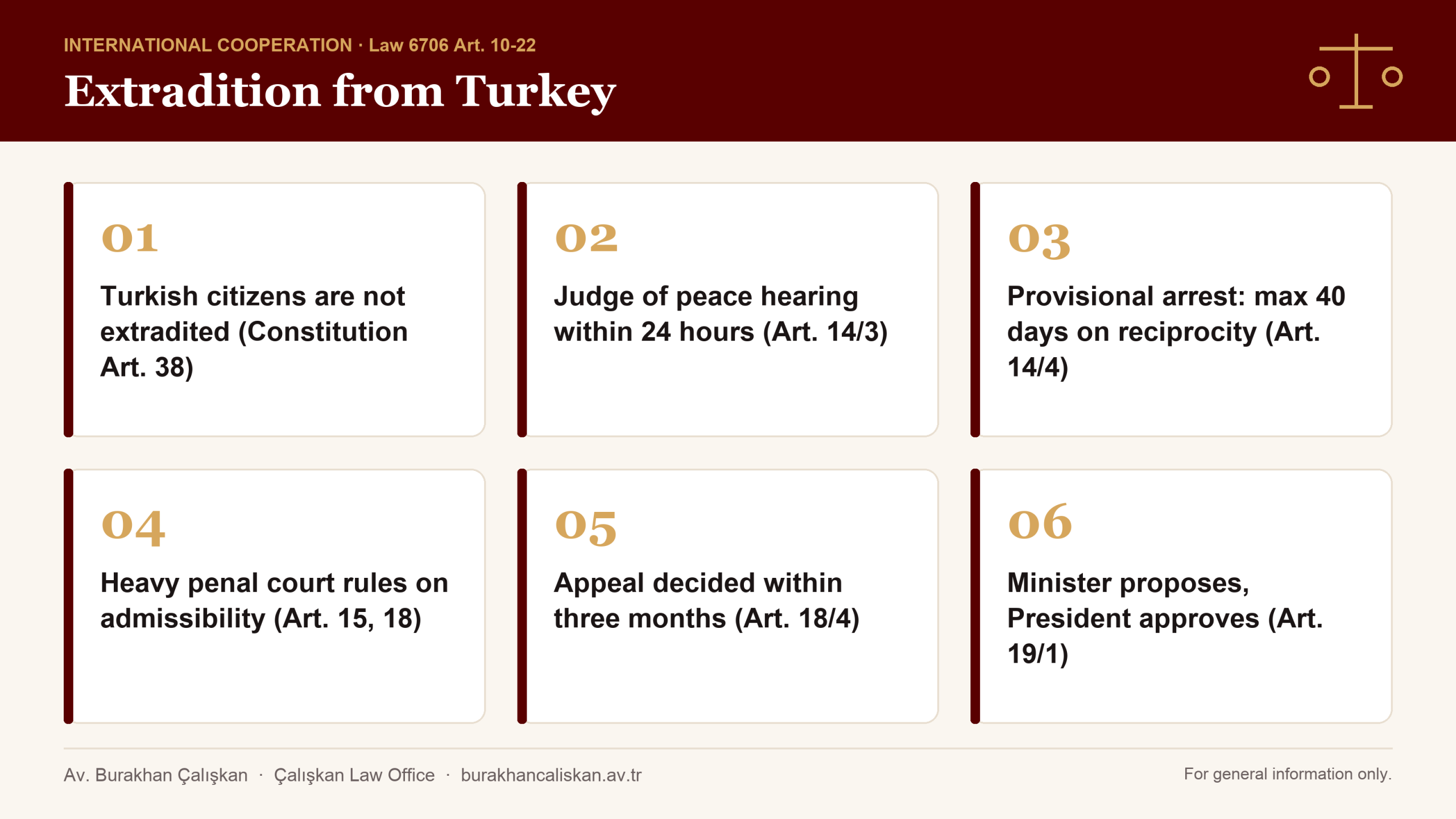
- Turkish citizens, including dual nationals, are not extradited (Constitution, Article 38; Law No. 6706, Article 11/1-a).
- An arrested person sees a criminal judge of peace within 24 hours; provisional arrest lasts at most 40 days under the reciprocity rule.
- A heavy penal court decides admissibility, with an appeal to the Court of Cassation.
- Surrender also needs the Minister of Justice’s proposal and the President’s approval.
Consent to extradition is asked at the very first hearing and its consequences are serious. To get information about your case, you can call or send a WhatsApp message.
What is extradition from Turkey?
Extradition from Turkey is the surrender of a foreigner who is in Turkey to another state, at that state’s request, so that an investigation or trial can be completed or a prison sentence enforced there. It is regulated by Articles 10 to 22 of Law No. 6706 on International Judicial Cooperation in Criminal Matters (Turkish).
Treaties are reserved (Article 1/3); in the judgments below, courts applied the European Convention on Extradition alongside Law No. 6706. Otherwise reciprocity applies (Article 3). The Ministry of Justice is the Central Authority.
Turkish judges do not decide guilt. Extradition also differs from prisoner transfer from Turkey, where a person convicted by a Turkish court serves that sentence at home.
Is an Interpol red notice an arrest warrant in Turkey?
No. An Interpol red notice is a request circulated to police forces worldwide to locate a wanted person and arrest them provisionally pending extradition; Interpol itself does not describe it as an international arrest warrant. In Turkey, loss of liberty requires a decision by a Turkish judge under Article 14 of Law No. 6706.
Does Turkey extradite its own citizens or dual nationals?
No. Turkey does not extradite its own citizens, and a dual national who holds Turkish citizenship is treated as a Turkish citizen. The only exception written into the Constitution concerns obligations linked to the International Criminal Court. Article 11/1-a of Law No. 6706 repeats the same ban as a mandatory ground for refusal.
“A citizen shall not be surrendered to a foreign country on account of an offence, except for the obligations arising from being a party to the International Criminal Court.” (Constitution of the Republic of Turkey, Article 38, final paragraph, unofficial translation)
Non-extradition does not mean impunity. Under Article 11 of the Turkish Penal Code (TCK), a citizen who is in Turkey can be tried there for an offence committed abroad if Turkish law provides a minimum sentence of at least one year and no judgment has been given abroad.
Citizenship status must be certain. In one file, the Czech Republic sought a Russian national whose acquired Turkish citizenship had been withdrawn; the withdrawal was still being challenged before the Council of State (Danıştay).
The admissibility decision was reversed: the pending citizenship case had not been awaited, detailed information on the evidence had not been obtained, and the request contained no undertaking on the speciality rule. Release was refused.
Which offences can lead to extradition from Turkey?
Extradition from Turkey can be granted for offences that carry, under both the requesting state’s law and Turkish law, a prison sentence with an upper limit of one year or more. If the request concerns a final conviction, the sentence imposed must be at least four months of imprisonment (Article 10/2).
This is the double criminality test. Offences below the thresholds can be included alongside one that meets them. The speciality rule then applies:
“In the event of extradition, the person may be tried only for the offences on which the extradition decision is based, or only the sentence to which the person was convicted may be enforced.” (Law No. 6706, Article 10/4, unofficial translation)
Fraud is a frequent basis for such requests; victims can read how to file a criminal complaint after being scammed in Turkey.
When must Turkey refuse an extradition request?
Turkey must refuse an extradition request when one of the grounds listed in Article 11/1 of Law No. 6706 exists, such as Turkish citizenship, a political or purely military offence, a strong suspicion of persecution, torture or ill-treatment, a prior Turkish judgment for the same act, or an offence that falls under Turkish jurisdiction.
What happens after an arrest on a red notice in Turkey?
After an arrest on a red notice in Turkey, the person is taken to the public prosecutor’s office and must appear before a criminal judge of peace (sulh ceza hâkimi) within 24 hours. The judge explains consent-based extradition and decides on provisional arrest (geçici tutuklama) or judicial control (Article 14/3 and 14/5).
EXTRADITION FROM TURKEY STEP BY STEP
The general stages of a Turkish file are explained in how a criminal case works in Turkey.
How long can a person be detained during extradition proceedings?
A person can be held in provisional arrest in Turkey for the period set by the applicable treaty and, where only reciprocity applies, for no more than 40 days (Article 14/4). If the extradition documents do not arrive within that period, the provisional arrest or judicial control is lifted (Article 14/6).
Article 14/6 allows new measures once the formal request arrives, and the heavy penal court may order detention or judicial control at every stage (Article 16/1), within these limits:
- Detention is reviewed at least every 30 days until surrender (Article 16/2).
- Measures are lifted if no extradition decision under Article 19 follows within one year after the court ruling becomes final (Article 16/3).
- Total detention cannot exceed the enforcement period of the sentence faced or imposed (Article 16/4).
Judicial control under Article 109 of the Code of Criminal Procedure (CMK), such as a ban on leaving the country, can replace detention (Article 14/5); see travel bans for foreigners during a criminal case in Turkey.
Which court decides, and can the decision be appealed?
The heavy penal court (ağır ceza mahkemesi) of the place where the person is located decides on the extradition request; if the location is unknown, the Ankara heavy penal court is competent (Article 15). Its decision on admissibility can be appealed to the Court of Cassation (Yargıtay), which rules within three months (Article 18/4).
The appeal must be lodged within two weeks from service of the reasoned judgment (CMK, Article 291). The judgments below show which points were tested.
Spain sought a person on a red notice over 980 kg of cocaine. The admissibility decision was reversed: the two offences had not been assessed separately, and the Spanish legal texts to be applied were missing and had to be requested under Article 18/2.
An Istanbul heavy penal court found a Dutch request inadmissible because the documents did not meet Article 12/2 of the European Convention on Extradition. The prosecutor appealed; the refusal was upheld.
Italy sought enforcement of a final 22-year sentence. The person was found in a removal centre (geri gönderme merkezi) awaiting deportation. Identity, nationality, double criminality, limitation and the risk of ill-treatment were checked; admissibility was upheld.
These are individual rulings on their own facts, not a general rule.
Can extradition be replaced by deportation?
No, not freely. While extradition proceedings are pending, a foreigner cannot be deported without the opinion of the Ministry of Justice, and cannot be deported to the state whose extradition request was refused without that opinion either (Article 12 of Law No. 6706). The two procedures are legally separate.
Deportation has its own administrative remedies; see deportation and entry bans after a criminal case in Turkey.
Can an Interpol red notice be deleted?
A red notice can be challenged before the Commission for the Control of INTERPOL’s Files (CCF), the body at Interpol that handles individuals’ requests to access, correct or delete data held about them. This is an Interpol procedure, separate from the Turkish courts, and a Turkish judgment does not automatically remove a notice.
Law No. 6706 does not make the Turkish proceedings wait for the CCF. The current conditions and forms should be checked on Interpol’s official website before applying.
Common mistakes
Common mistakes in extradition from Turkey usually happen in the first days: the person treats the red notice as a formality, consents without understanding the consequences, or argues only innocence.
- Consenting at the first hearing without knowing that the ordinary procedure is then skipped (Article 17).
- Arguing guilt or innocence only, instead of the Article 10 and 11 conditions.
- Not documenting citizenship, family ties, long residence or the risk of ill-treatment.
- Missing the two-week appeal period (CMK, Article 291).
Turkish readers: suçluların iadesi rehberi (in Turkish). More guides: Criminal Law in Turkey and criminal defence for foreigners in Istanbul.
Frequently Asked Questions
Is there extradition from Turkey to the UK, Ireland or the US?
Yes, in principle. Extradition from Turkey is possible to any state on the basis of a treaty or the reciprocity principle (Law No. 6706, Articles 1 and 3). Whether a specific request succeeds depends on the conditions in Articles 10 and 11.
Can I be arrested at a Turkish airport because of a red notice?
Yes, it can happen. If the requesting state has asked for provisional arrest and the Ministry of Justice has approved, the person can be apprehended and must be brought before a criminal judge of peace within 24 hours (Article 14/3).
Will Turkey extradite me if I also hold Turkish citizenship?
No. Article 38 of the Constitution and Article 11/1-a of Law No. 6706 forbid the extradition of a Turkish citizen, apart from obligations linked to the International Criminal Court. A second nationality does not change this.
Can I agree to be extradited to shorten the process?
Yes. Under Article 17, a person who consents can be surrendered without the ordinary procedure. The heavy penal court first explains the legal consequences and still checks admissibility; its decision is open to objection (itiraz).
Can the requesting country try me for other offences after extradition?
No, not under the speciality rule. Article 10/4 of Law No. 6706 limits the trial or the enforcement to the offences on which the extradition decision is based.
Does a pending criminal case in Turkey stop extradition?
Not by itself. A pending Turkish case is not among the refusal grounds in Article 11, but under Article 20/3 the Ministry of Justice may postpone surrender while an investigation, prosecution or prison sentence in Turkey is pending.
Citizenship, the request documents and the Article 11 grounds can be reviewed together. To get information about your case, you can call or send a WhatsApp message.
About the Author
Av. Burakhan Çalışkan is a lawyer at Çalışkan Hukuk Bürosu in Kartal, Istanbul, working in criminal law. His practice includes files of foreign nationals and dual nationals in Turkey, where extradition requests under Law No. 6706, provisional arrest hearings before criminal judgeships of peace, detention reviews and related deportation questions are followed in contact with families and lawyers abroad.
Legal disclaimer: This article has been prepared for general information purposes only, based on current legislation and established legal practice. The assessments it contains are general explanations that may vary according to the specific circumstances of each case; they do not constitute legal advice and do not create a lawyer-client relationship. As legislation and case law may change over time, it is recommended that you consult a qualified lawyer before taking any step regarding a specific legal problem.