Short answer: If you were scammed in Turkey, tell your bank at once, keep every receipt and message, and report the fraud to the police or the public prosecutor. Fraud carries 1 to 5 years under Article 157 of the Turkish Penal Code and up to 10 years in aggravated cases. Suspicious accounts can be suspended for up to 48 hours and the money seized.
- Fraud is prosecuted ex officio in Turkey: a foreign victim can report it to the police or the public prosecutor, in writing or orally, with an interpreter.
- Basic fraud (Article 157 TCK) carries 1 to 5 years; online or bank-based fraud (Article 158/1-f) carries 4 to 10 years.
- Since Law No. 7571, a bank, payment provider or crypto platform may suspend a suspicious account for up to 48 hours (Article 128/A CMK).
- Seized money that belongs to the victim can be returned during the investigation or the trial; no result is automatic.
Being scammed in Turkey as a foreigner raises two questions: how to start a criminal case, and how to recover the money. This guide explains both under the Turkish Penal Code (TCK) and the Code of Criminal Procedure (CMK).
Account suspension lasts 48 hours at most, so early reporting matters. To get information about your case, you can call or send a WhatsApp message.
What should you do first if you were scammed in Turkey?
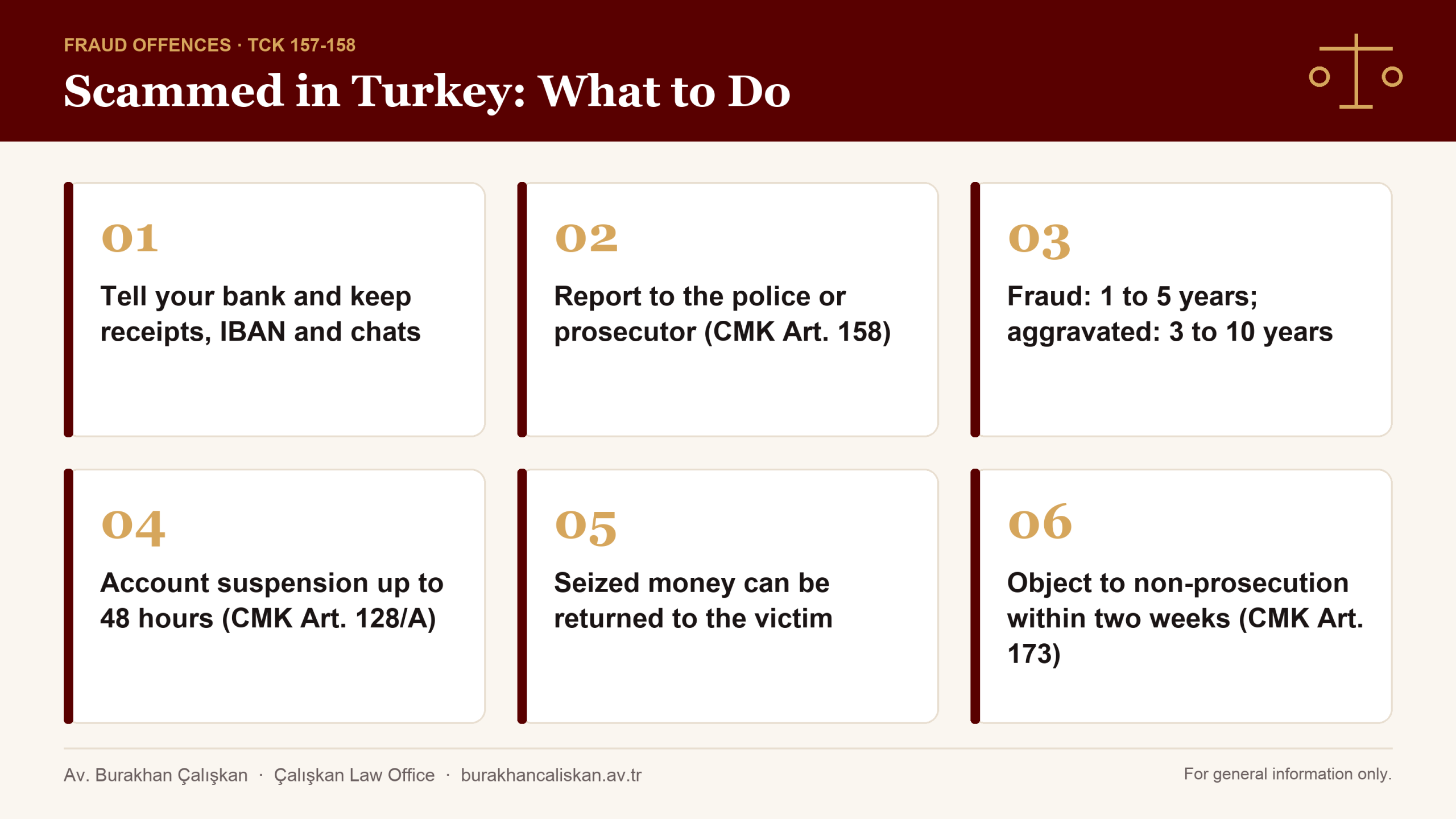
If you were scammed in Turkey, act in this order: contact your own bank or card issuer and report the transaction, save the evidence, and file a criminal report with the police or the public prosecutor (Cumhuriyet savcısı). The first hours matter, because fraud proceeds are usually moved to other accounts quickly.
FIRST STEPS AFTER A SCAM IN TURKEY
Is it fraud or only a civil dispute under Turkish law?
Fraud (dolandırıcılık) is the offence of deceiving a person by fraudulent conduct and obtaining a benefit to that person’s or another’s detriment. Courts look for deceit that existed from the start, such as a false identity, a fake listing or forged documents; a simple failure to perform is a private law matter.
“Any person who deceives another by fraudulent conduct and obtains a benefit for themselves or for another, to the detriment of that person or of someone else, shall be sentenced to imprisonment from one year to five years and to a judicial fine of up to five thousand days.” (Turkish Penal Code, Article 157, unofficial translation)
A couple paid about 35,000 TL to people who promised to settle them in Bulgaria; they stayed some 20 to 25 days and were brought back. The Court found no fraudulent intent from the outset, held that merely failing to keep a promise is not deceit, and quashed the convictions as a private law dispute.
The petition should therefore describe the deceit concretely: what was said and what proved false.
What are the penalties for fraud in Turkey?
The penalty for fraud in Turkey is 1 to 5 years in prison under Article 157 TCK and 3 to 10 years for aggravated fraud under Article 158. Where information systems, banks or credit institutions are used as a tool, the minimum is 4 years and the fine cannot be less than twice the benefit obtained.
A buyer contacted a Facebook account offering football tickets and sent 150 TL to the bank account given; the tickets never came and the seller blocked the buyer. The defence called it a civil dispute. The Court upheld the conviction under Article 158/1-f, with the reduction of Article 168/2 because the money was returned during the trial.
Full text: Turkish Penal Code (Turkish).
How can a foreigner file a criminal complaint in Turkey?
A foreigner can file a criminal complaint in Turkey at any police station, gendarmerie post or public prosecutor’s office. Under Article 158 CMK, a report or complaint may be made in writing or orally and recorded in minutes. Fraud under Articles 157 and 158 TCK is investigated ex officio (Article 160 CMK).
- Language: a victim who does not speak enough Turkish is heard through an interpreter appointed by the prosecutor or judge (Article 202/3 CMK).
- Content: what happened and when, the amount, the receiving account, and your requests: suspension and seizure.
- Where: for offences committed through IT systems, banks or cards, the courts of the victim’s place of residence are also competent (Article 12/6 CMK).
No six-month complaint period applies to these offences. The limit is the limitation period of Article 66 TCK: 8 years for Article 157 and 15 years for Article 158.
Can you file a complaint after leaving Turkey?
You can still file a complaint after leaving Turkey, most reliably through a lawyer in Turkey acting under a power of attorney, who submits the petition to the prosecutor and follows the file. Turkish law applies whenever the act was committed in Turkey, wholly or partly, or its result occurred there (Article 8 TCK).
Article 158/3 CMK allows reports to Turkish embassies and consulates, but its wording covers offences committed abroad that must be prosecuted in Turkey. For a scam that took place in Turkey, ask the consulate how it handles reports and powers of attorney.
If the victim cannot be reached, the investigation is concluded without mediation (Article 253/6 CMK), so give the prosecutor working contact details. For the stages that follow, see how a criminal case works in Turkey.
Can the scammer’s bank account be frozen in Turkey?
Yes, a scammer’s bank account can be frozen in Turkey. Article 128/A CMK, added by Law No. 7571 in December 2025, lets a bank, payment service provider or crypto-asset service provider suspend an account used in online fraud for up to 48 hours on reasonable suspicion. The money can then be seized by a judge.
- Scope: aggravated theft through IT systems (Article 142/2-e TCK), aggravated fraud under Article 158/1-f and 158/1-l, and misuse of bank or credit cards (Article 245).
- Onward transfers: the next institution is notified without delay (128/A-3).
- Seizure: by a judge, or in urgent cases by the prosecutor’s written order, submitted to a judge within 24 hours; the judge decides within 48 hours of the seizure (128/A-4).
- Other fraud: Article 128 CMK allows a judge to seize accounts for Articles 157 and 158 on strong suspicion based on concrete evidence.
A detailed guide: fraud complaint, account blocking and return of money under Article 128 CMK (in Turkish).
How does a fraud victim get the money back?
A fraud victim in Turkey gets money back in four main ways: return of seized funds, voluntary repayment by the offender under the effective remorse rules, a mediation settlement, or a civil compensation claim. The route depends on whether the money was caught in an account and the offender identified.
“Where it is understood that the seized benefit belongs to the victim harmed by the offence, it shall be returned to its owner during the investigation or prosecution phase.” (Code of Criminal Procedure, Article 128/A(5), unofficial translation)
- Return of seized assets: Article 131/2 CMK also provides for return to the victim of assets seized under Article 128 once they are no longer needed as evidence.
- Effective remorse (etkin pişmanlık): under Article 168 TCK, full compensation before the trial begins reduces the sentence by up to two thirds, and by up to half if made before judgment.
- Mediation (uzlaştırma): available only for basic fraud under Article 157 (Article 253 CMK). After a settlement, no separate compensation claim can be brought for the same offence.
- Civil claim: otherwise, compensation is sought in the civil courts.
The victim stated a loss of 21,000 TL; one defendant said he had repaid 1,000 TL. The Court reversed in the interest of law: with partial repayment, the trial court must ask the victim whether they consent to effective remorse (Article 168/4).
A partial payment therefore reduces the sentence only if the victim agrees.
Where the proceeds were moved through other accounts or converted to crypto, the people who moved them may face separate money laundering charges in Turkey.
What rights does a victim have during the investigation and trial?
A victim in a Turkish criminal case has defined rights under Article 234 CMK: to ask for evidence to be collected, to request copies of documents, to have a lawyer examine the file, and to object to a non-prosecution decision. Once an indictment is filed, the victim may join the case as an intervening party.
- Joining the case (katılma): possible at any stage before the first-instance judgment, by petition or orally at a hearing (Articles 237 and 238 CMK). Only a joined party can appeal.
- Objection: a non-prosecution decision (kovuşturmaya yer olmadığına dair karar) can be challenged before the criminal judgeship of peace (sulh ceza hâkimliği) within two weeks of notification (Article 173 CMK).
See the Code of Criminal Procedure (Turkish) for the full text.
Common mistakes
- Waiting days before telling the bank and the police, while the money is moved on.
- Paying a second “fee”, “tax” or “release charge” to get the first payment back.
- Deleting chats, or keeping screenshots without numbers, links and dates.
- Filing a vague report that does not describe the deceit or ask for the account to be suspended and seized.
- Paying “recovery agents” who promise to retrieve the money for an advance fee.
If a relative is a suspect rather than a victim, see my family member was arrested in Turkey. More guides: Criminal Law in Turkey and Istanbul criminal lawyer for foreigners.
Frequently Asked Questions
Can a tourist report a scam to the police in Turkey?
Yes. Under Article 158 of the Code of Criminal Procedure, anyone can report an offence to the police, gendarmerie or public prosecutor, in writing or orally. An interpreter is appointed under Article 202 where needed.
Is there a deadline to report fraud in Turkey?
Fraud under Articles 157 and 158 TCK does not depend on a complaint, so the six-month complaint period does not apply. The limitation period is 8 years for basic fraud and 15 years for aggravated fraud.
Will I get my money back if the scammer is convicted?
Not automatically. Money is recovered when funds were frozen and returned, when the offender repays to reduce the sentence, through mediation, or through a separate civil claim.
Can a scammer’s bank account be frozen in Turkey?
Yes. For online or bank-based fraud, the bank, payment provider or crypto platform may suspend the account for up to 48 hours under Article 128/A CMK. A judge, or in urgent cases the prosecutor, can then order seizure of the money.
Do I have to return to Turkey for the trial?
Not necessarily. A victim may be represented by a lawyer holding a power of attorney, who files the complaint and attends hearings. The court may still wish to hear the victim.
What if the prosecutor decides not to prosecute?
The victim can object. Under Article 173 CMK, an objection may be filed with the criminal judgeship of peace within two weeks of notification of the non-prosecution decision.
The evidence, the petition and the options for freezing and return can be assessed with your documents. To get information about your case, you can call or send a WhatsApp message.
About the Author
Av. Burakhan Çalışkan is a lawyer at Çalışkan Hukuk Bürosu in Kartal, Istanbul, working in criminal law. His practice includes fraud files under Articles 157 and 158 of the Turkish Penal Code, on both the complainant and the defence side, covering criminal complaints, requests for account suspension and seizure, effective remorse, mediation, and the participation of foreign nationals in Turkish investigations and trials.
Legal disclaimer: This article has been prepared for general information purposes only, based on current legislation and established legal practice. The assessments it contains are general explanations that may vary according to the specific circumstances of each case; they do not constitute legal advice and do not create a lawyer-client relationship. As legislation and case law may change over time, it is recommended that you consult a qualified lawyer before taking any step regarding a specific legal problem.