Short answer: A foreigner can leave Turkey during a criminal case unless a judge has imposed a travel ban (yurt dışına çıkış yasağı) as a judicial control measure under Article 109/3-a of the Code of Criminal Procedure (CMK). If there is a ban, border police will stop the departure. The ban can be challenged by objection within two weeks or by a request to lift it at any time.
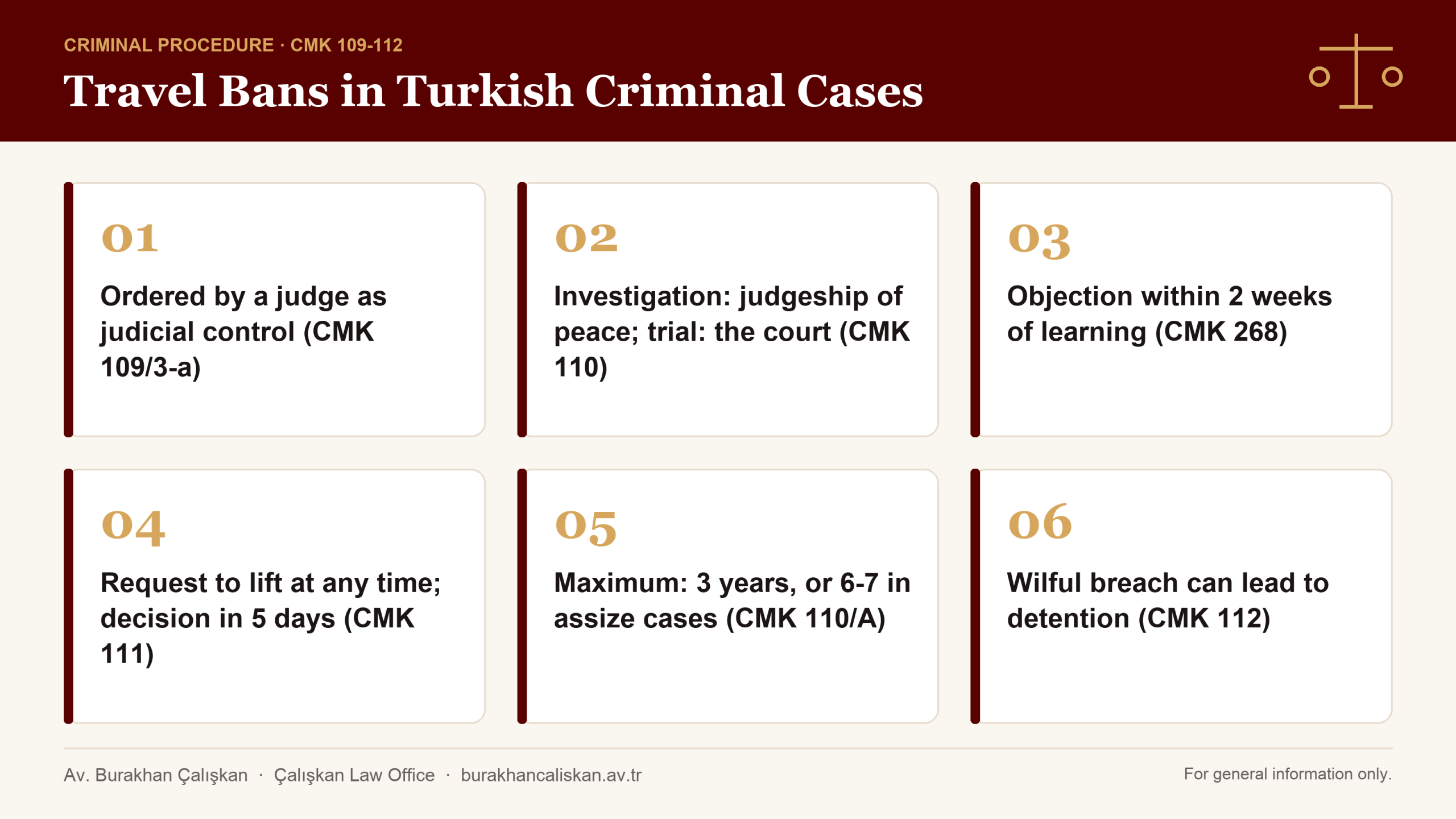
- A court-ordered travel ban in Turkey is a judicial control measure under CMK Article 109/3-a, and it binds foreign nationals too.
- You can object within two weeks of learning of the decision (CMK Article 268) and ask for the ban to be lifted at any time (CMK Article 111).
- Judicial control has maximum periods: three years in total in ordinary cases, six (or seven) in assize court cases (CMK Article 110/A).
- Breaking the ban wilfully can lead to immediate pre-trial detention, whatever the expected sentence (CMK Article 112).
This guide explains how a travel ban in Turkey works for foreign tourists, students and business visitors who are suspects or defendants: who orders it, how long it lasts, how to challenge it and how the case continues after you go home.
The objection must reach the court within two weeks of learning of the decision. To get information about your case, you can call or send a WhatsApp message.
What is judicial control under CMK Article 109?
Judicial control (adli kontrol) is a protective measure under Article 109 of the Turkish Code of Criminal Procedure (CMK) that a judge may order instead of pre-trial detention (tutuklama) when grounds for detention under Article 100 exist. It places the suspect under one or more obligations, and a ban on leaving Turkey is the first on the list.
“Judicial control consists of subjecting the suspect to one or more of the obligations below: a) Not leaving the country.” (CMK Article 109/3, unofficial translation)
Judicial control can also be ordered where detention is prohibited, such as offences with a maximum of two years (Articles 109/2 and 100/4). For foreigners, the travel ban is often combined with reporting to a police station or a guarantee.
Who decides on a travel ban, and how do you find out about it?
A travel ban in a Turkish criminal case is ordered by a judge, never by the police or the prosecutor alone. During the investigation the criminal judgeship of peace (sulh ceza hâkimliği) decides at the prosecutor’s request (CMK Article 110/1); once the indictment is accepted, the trial court may impose, change or lift it at any stage (Article 110/3).
Most foreign suspects learn of the ban at the end of questioning before the judgeship. Under Passport Law No. 5682 Article 22, persons whom a court has banned from leaving are reported to the border gates and their exit is blocked.
The safest check is a copy of the decision and a lawyer’s review of the file in the judiciary network (UYAP). Families can read what to do when a family member is arrested in Turkey.
Travel bans are common in sexual offence cases against foreign nationals as well as drug cases.
Travel bans are frequently imposed after holiday incidents such as a bar fight or assault charge in Turkey.
Travel bans are also ordered in speech-related files; our guide on insult offences under Articles 299 and 301 for foreigners explains when detention is barred and judicial control is used instead.
How long can a travel ban last in Turkey?
A travel ban in Turkey lasts as long as the judicial control decision stays in force, but CMK Article 110/A sets maximum periods. In cases outside the assize court (ağır ceza mahkemesi) judicial control may last two years, extendable by one year with reasons. In assize court cases the cap is three years, extendable by up to three more.
The need for the measure must also be reviewed at least every four months, by the judgeship of peace during the investigation and by the trial court on its own motion during the trial (Article 110/4).
See also how long judicial control lasts (in Turkish).
How do you object to a travel ban?
An objection (itiraz) against a travel ban must be filed within two weeks from the day the person learned of the decision, by a petition to the judge or court that made it or by a statement recorded by the court clerk (CMK Articles 111/2 and 268/1). Law No. 7499 of 2024 extended this period from seven days to two weeks.
If the judge does not correct the decision, it goes within three days to the reviewing authority; for a judgeship of peace, that is the criminal court of first instance (asliye ceza mahkemesi) judge (Article 268/3-b).
In a drug dealing case, the court imposed a CMK 109/3-a travel ban with the conviction but did not tell the defendants they could object. The Chamber held this unlawful and added a notice of the remedy. The notice referred to seven days; the current Article 268 period is two weeks.
Can you ask the court to lift the travel ban?
Yes, a suspect or defendant can ask the judge or court to lift or change a travel ban at any time under CMK Article 111/1, and the decision should be given within five days after the prosecutor’s opinion. Unlike an objection, it has no deadline and can be repeated.
Article 110/2 lets the judge remove, replace or temporarily suspend obligations, which can support a time-limited trip for a family emergency. Arguments that carry weight are documented:
- A home, job or university place abroad, plus an address for service and an authorised lawyer in Turkey.
- A guarantee (güvence) under Article 109/3-f; it is returned on acquittal, non-prosecution or compliance (Articles 113-115).
- Evidence already collected, so no risk to witnesses.
- Time already spent under the ban compared with the expected sentence.
- A plan for taking part in the trial from abroad.
What happens if you break a travel ban?
A suspect or defendant who wilfully breaks judicial control can be detained immediately by the competent judge or court, whatever sentence may be imposed (CMK Article 112/1). Leaving through an unofficial crossing is a clear example; because the law requires a wilful breach, a person genuinely unaware of the ban is in a different position.
Where judicial control followed the expiry of maximum detention, detention for a breach cannot exceed nine months in assize court cases and two months in others (Article 112/2).
Can the criminal case continue after you return home?
A Turkish criminal case can continue after the defendant has lawfully left Turkey. A defendant who has been questioned by the court may be excused from attending hearings (duruşmadan vareste) at his or her own request or the lawyer’s, if authorised (CMK Article 196/1), and a lawyer follows the file in Turkey.
A defendant abroad may be questioned through letters rogatory (istinabe) except for offences carrying a minimum of five years’ imprisonment (Article 196/2 and 196/6). Video-link questioning (SEGBİS) under Article 196/4 covers only defendants in Turkey. See our guide on how a criminal case works in Turkey.
Is a court travel ban different from deportation or an entry ban?
A court travel ban and deportation are different measures. The travel ban is a criminal procedure measure ordered by a judge to keep a suspect in Turkey; deportation (sınır dışı etme) is an administrative decision under the Law on Foreigners and International Protection No. 6458 that removes a foreigner.
The two can collide: under Article 54/1-e of Law No. 6458, overstaying a visa by more than ten days is a deportation ground, so a foreigner held by a ban should keep his or her residence status in order.
The applicant, acquitted at first instance, stayed under a travel ban until the judgment became final. The Court held that the ban fell within freedom of travel (Article 23 of the Constitution) and, as Turkey is not a party to Protocol No. 4 to the European Convention, declared the complaint inadmissible. In practice, the remedies are objections and lifting requests before the criminal courts.
The administrative side is explained in deportation and entry bans after a criminal case in Turkey.
When does the travel ban end?
A travel ban ends when the judge or court lifts it, when the maximum period in CMK Article 110/A expires, or when the case itself ends. A non-prosecution decision (kovuşturmaya yer olmadığına dair karar) releases the suspect from judicial control under Article 103/2, and a final judgment ends the prosecution stage.
A man convicted decades earlier and released on parole was refused removal of his travel ban. On an appeal in the interest of law, the Chamber held that a judicial control travel ban is limited by Article 110/A and ends by itself once a final judgment closes the prosecution.
Before booking a flight, ask the court to send a removal letter (müzekkere) to the police and keep a copy. For drug cases, see when a travel ban is lifted in drug cases (in Turkish).
Common mistakes
- Missing the two-week objection period, or filing an objection that only repeats innocence instead of answering the risk of flight with documents.
- Letting a visa or residence permit expire while waiting for the ban to be lifted.
- Assuming the ban disappears from the border system the day of an acquittal, without a removal letter.
More guides are under Criminal Law in Turkey and on our page about criminal defence in Istanbul. Official text: CMK (Turkish).
Frequently Asked Questions
Can I leave Turkey if my case is open but there is no travel ban?
Yes. Without a court order under CMK Article 109/3-a or another legal bar, a pending investigation or trial does not stop a foreign national at the border. The case continues, so keep a lawyer and an address for service in Turkey.
How long does a travel ban last in Turkey?
A court travel ban lasts until the court lifts it or the case ends, within the caps in CMK Article 110/A: three years in total outside the assize court, and six years in assize court cases (seven for certain offences against the state and terrorism).
What is the deadline to object to a travel ban?
Under CMK Article 268 as amended by Law No. 7499, the objection must be filed within two weeks from the day you learned of the decision. It is filed with the judge or court that made the decision.
Can the court let me travel for a short trip and come back?
It is possible. CMK Article 110/2 allows the judge to temporarily exempt a suspect from some obligations. A request for a time-limited exemption, supported by documents and a return ticket, is a legal option; the decision depends on the file.
Does the travel ban end automatically when I am acquitted?
The Court of Cassation has held that judicial control ends once the prosecution ends with a final judgment. In practice, ask the court to send a removal letter to the police so the record at the border is cleared before you travel.
Is a travel ban the same as deportation?
No. A travel ban keeps you in Turkey because of a criminal case; deportation removes you through an administrative decision under Law No. 6458. Different authorities decide them, and they are challenged in different ways.
The decision, its reasons and the stage of the file show which request fits your situation. To get information about your case, you can call or send a WhatsApp message.
About the Author
Av. Burakhan Çalışkan is a lawyer at Çalışkan Hukuk Bürosu in Kartal, Istanbul, working in criminal law. His work includes detention and judicial control hearings before criminal judgeships of peace, objections and requests to lift travel bans, and cases of foreign defendants who continue their proceedings from abroad.
Legal disclaimer: This article has been prepared for general information purposes only, based on current legislation and established legal practice. The assessments it contains are general explanations that may vary according to the specific circumstances of each case; they do not constitute legal advice and do not create a lawyer-client relationship. As legislation and case law may change over time, it is recommended that you consult a qualified lawyer before taking any step regarding a specific legal problem.