Short answer: Yes. A foreign national sentenced to prison in Turkey can ask to serve the rest of the sentence in the home country under Article 32 of Law No. 6706. The conviction must be final, the prisoner must consent, the act must be a crime in the home country, normally at least six months must remain, and no other case may be open in Turkey. Both states must agree, and the Minister of Justice decides.
- A foreigner convicted in Turkey can ask to serve the rest of a prison sentence in the home country under Article 32 of Law No. 6706.
- The judgment must be final, the prisoner must consent, and normally at least six months of prison must remain on the date of the request.
- Turkey, the home country and the prisoner must all agree; the Minister of Justice decides.
- An unpaid judicial fine is turned into extra prison days that the home country must accept.
- After the transfer, the home country’s law governs enforcement, including conditional release.
Prisoner transfer from Turkey is often the key question for families abroad once a sentence becomes final. This guide covers the legal basis, conditions, procedure, release dates and fines.
Fines, court costs and any other open file in Turkey can delay the request. To get information about your case, you can call or send a WhatsApp message.
What is prisoner transfer from Turkey?
Prisoner transfer (hükümlü nakli) is a form of international judicial cooperation in which a person convicted and imprisoned in Turkey is sent to another state to serve the remaining prison sentence there. It requires the agreement of both states and the consent of the prisoner, and its purpose is the prisoner’s social rehabilitation.
Transfer does not reopen the case: questions about guilt stay with the courts of the sentencing state. The Court of Cassation distinguishes it from the transfer of enforcement (infazın devri), used when the sentenced person is already in the state taking over the sentence.
“Prisoner transfer aims to secure the social rehabilitation of prisoners by letting them serve their sentences in their own social environment; it is not an institution adopted to reduce the sentences imposed.” (Court of Cassation (Yargıtay) 10th Criminal Chamber, E. 2023/7824, K. 2023/8434, unofficial translation)
Which rules apply: Law No. 6706, the 1983 Convention or a bilateral treaty?
Three layers of rules apply to prisoner transfer from Turkey. Law No. 6706 on International Judicial Cooperation in Criminal Matters sets the Turkish conditions in Article 32, and Article 1/3 reserves treaties, so the Council of Europe Convention on the Transfer of Sentenced Persons (1983) or a bilateral treaty also applies.
Turkey applies the 1983 Convention with states such as the United Kingdom and Germany, and has bilateral treaties with other states, for example Iran and the Turkish Republic of Northern Cyprus. The Convention also has an Additional Protocol (1997); whether it applies depends on whether both states have ratified it. Read the text of Law No. 6706 (Turkish).
A Turkish national sentenced in Northern Cyprus to two years for buying ecstasy pills was transferred to Turkey under the bilateral treaty, which applied through Article 1/3 of Law No. 6706. The Ankara court treated it as possession for personal use; the Court of Cassation quashed this because the foreign judgment showed the pills were bought for sale.
Transfer is different from surrender at the request of a foreign state, which is covered in our guide to extradition from Turkey.
What conditions must be met under Article 32 of Law No. 6706?
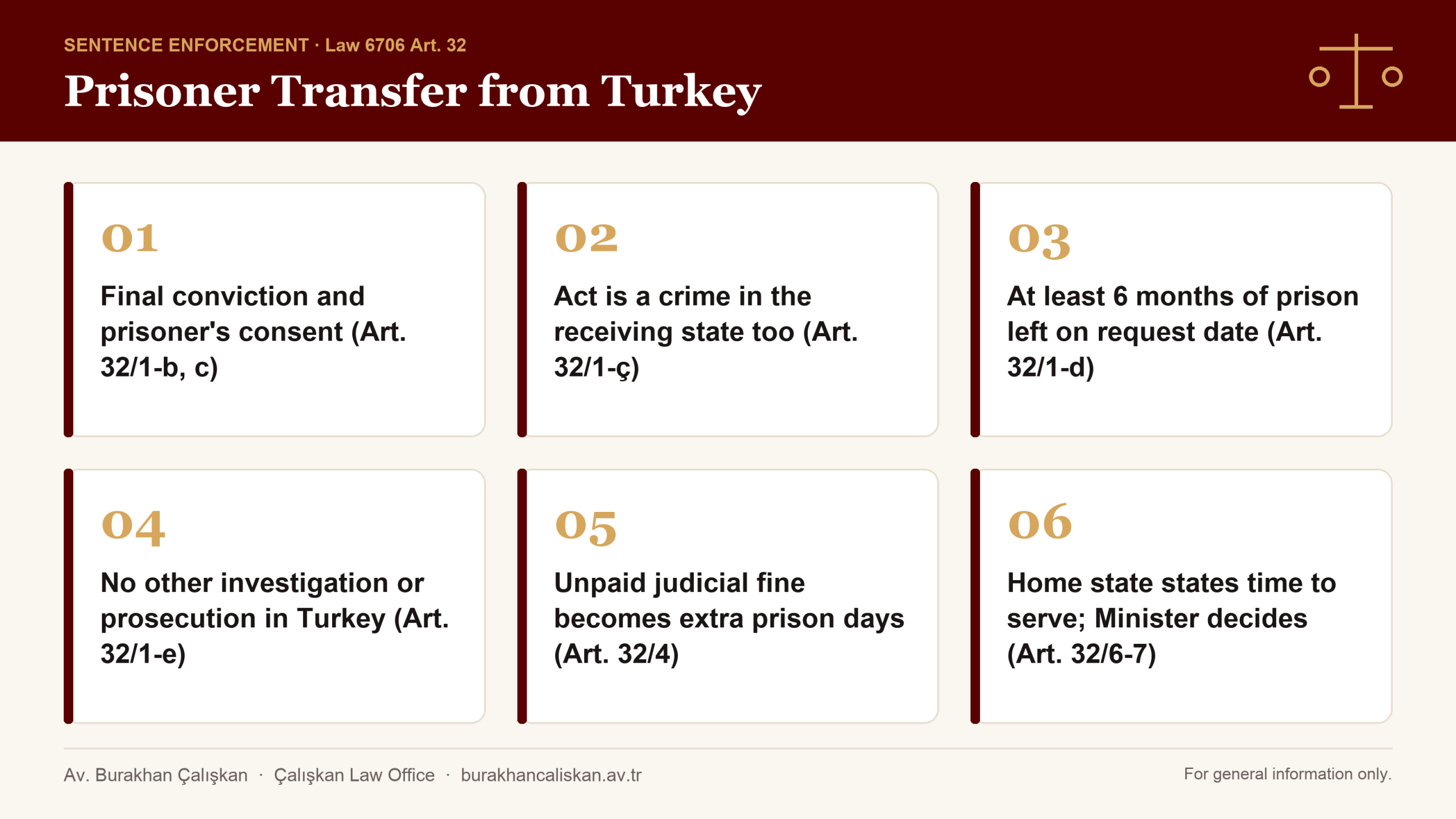
Article 32/1 of Law No. 6706 lists six conditions that must all be met for a prisoner to be transferred from Turkey: links to the receiving state, consent, a final conviction, double criminality, normally at least six months of prison left, and no other investigation or prosecution in Turkey.
“A convict in respect of whom a conviction has been given by Turkish courts and who is in a penal institution may be transferred to a foreign state for the purpose of enforcing the sentence where the following conditions are met together” (Law No. 6706, Article 32/1, unofficial translation)
Even when every condition is met, transfer is not automatic. Under Article 32/3 the central authority may refuse if transfer would not help rehabilitation, serve criminal justice or fit Turkey’s national security and fundamental interests. The receiving state may also decline. On how a case becomes final, see how a criminal case works in Turkey.
Who can apply, and how does the procedure work?
A transfer request can be made by the prisoner, a legal representative or a relative (Article 32/2). The central authority is the Ministry of Justice (Article 2), whose international department handles extradition and prisoner transfer files. The Ministry sends the documents to the receiving state and the Minister of Justice decides once that state consents (Article 32/7).
The file sent abroad contains the certified judgment, the provisions applied, the consent document, the remaining sentence and, if needed, medical reports and translations. The law sets no deadline.
PRISONER TRANSFER FROM TURKEY STEP BY STEP
Can the home country change the length of the sentence?
The home country cannot make a Turkish sentence heavier, but it may adapt it. Under Article 10 of the 1983 Convention, it is bound by the legal nature and duration of the sentence; if these are incompatible with its law, it may adapt them, without exceeding the original sentence or its own maximum.
A Turkish national serving a life sentence in England, with a minimum term of 33 years, was transferred to Turkey under Law No. 6706 and the Convention. The Court held that the sentence is enforced under Turkish law, but the time to be served must first be notified to the prisoner and the sentencing state and accepted by both; because the file lacked proof of that, the enforcement judge’s decision was quashed.
In the 2023 case of a Turkish national transferred from Iran with a 25-year drug sentence, the 10th Criminal Chamber held that Law No. 6706 provides no adaptation proceedings in prisoner transfer.
When will the prisoner be released after the transfer?
After a transfer, the release date is set by the home country’s law. Article 9 of the 1983 Convention, as quoted by the Court of Cassation, makes enforcement subject to the law of the administering state, which alone takes the necessary decisions; the Turkey–Iran agreement expressly includes conditional release.
That is why Article 32/6 requires Turkey to ask the receiving state how long the prisoner will stay in prison and how the sentence will be enforced, and to notify the prisoner. This answer is the clearest guide to the real release date.
What happens to fines and court costs?
A judicial fine (adli para cezası) imposed together with the prison sentence must be paid before a transfer can be decided (Article 32/4). If it is not paid, the unpaid part is converted into days of imprisonment, and the resulting total is notified to the receiving state, which must accept it.
Time served in Turkey is first set against the converted fine days, and any balance is added to the prison term. Court costs must also be paid unless the prisoner cannot pay (Article 32/5).
Illustrative example: a prisoner has a four-year sentence (1,460 days) and an unpaid fine converted into 300 days. After 730 days in a Turkish prison, those days first cover the 300 fine days, and the remaining 430 days count against the prison term. The total reported to the home country is 1,460 + 300 – 730 = 1,030 days.
Article 32 does not address confiscation orders; clarify them separately with the court.
What happens after the sentence is served abroad?
A sentence fully served abroad after a transfer counts in Turkey as well. Under Article 33/2 of Law No. 6706, full enforcement abroad, or the sentence becoming unenforceable there, has the same effect under Turkish law; if the foreign state cannot enforce it, enforcement continues in Turkey (Article 33/3).
A foreigner who stays in Turkey is reported for deportation assessment on release under Article 59 of the Turkish Penal Code (TCK); see deportation and entry bans after a criminal case in Turkey.
Common mistakes
- Applying while an appeal is still pending, before the judgment is final.
- Forgetting a second, minor file in Turkey that blocks the transfer under Article 32/1-e.
- Ignoring the judicial fine, which adds prison days if left unpaid.
- Expecting the home country to reopen the case; questions about guilt stay with the Turkish courts.
- Not reading the receiving state’s answer on time to be served before confirming consent.
Families abroad can find first steps in my family member was arrested in Turkey, and drug cases are covered in drug smuggling charges in Turkey. Turkish readers: hükümlü nakli rehberi (in Turkish). More guides: Criminal Law in Turkey and criminal defence for foreigners in Istanbul.
Frequently Asked Questions
Can a foreign prisoner be transferred from Turkey before the appeal ends?
No. Article 32/1-c of Law No. 6706 requires a final conviction. While an appeal to the regional court of appeal or the Court of Cassation (Yargıtay) is pending, the judgment is not final, so the transfer request cannot succeed yet.
Does the prisoner need a lawyer to apply for a transfer?
No. Article 32/2 allows the prisoner, a legal representative or a relative to make the request, so a lawyer is not a legal requirement. A lawyer can help check the conditions, documents, fines and any pending files.
Will the prisoner serve less time in the home country?
Not necessarily. Before the transfer, Turkey asks the home country how long the prisoner will stay in prison and how the sentence will be enforced (Article 32/6), and this information is notified to the prisoner. The answer can be shorter, equal or longer, depending on that country’s parole rules.
Can a prisoner withdraw consent to the transfer?
Consent is a condition under Article 32/1-b, and the 1983 Convention requires that it be given voluntarily and with full knowledge of the legal consequences. The prisoner is told the expected time in prison before the transfer, which is the moment to reconsider.
Is a transfer possible if there is another case in Turkey?
No, not while that case is open. Article 32/1-e requires that there is no other investigation or prosecution against the prisoner in Turkey for a different offence. Any open file, even a minor one, should be identified early.
What happens if the home country cannot enforce the sentence?
Under Article 33/3 of Law No. 6706, if the foreign state cannot enforce the judgment, enforcement continues in Turkey. If the sentence is fully served abroad, or becomes partly or wholly unenforceable there, Article 33/2 gives that outcome the same effect under Turkish law.
The conditions, the fine and the remaining sentence can be checked together before a request is filed. To get information about your case, you can call or send a WhatsApp message.
About the Author
Av. Burakhan Çalışkan is a lawyer at Çalışkan Hukuk Bürosu in Kartal, Istanbul, working in criminal law. His practice includes files of foreign nationals sentenced in Turkey, where the questions after a final judgment, such as prisoner transfer under Law No. 6706, judicial fines, enforcement and deportation, are followed together with families who often live abroad.
Legal disclaimer: This article has been prepared for general information purposes only, based on current legislation and established legal practice. The assessments it contains are general explanations that may vary according to the specific circumstances of each case; they do not constitute legal advice and do not create a lawyer-client relationship. As legislation and case law may change over time, it is recommended that you consult a qualified lawyer before taking any step regarding a specific legal problem.