Short answer: Money laundering charges in Turkey are brought under Article 282 of the Turkish Penal Code (TCK). A person who takes the proceeds of a crime abroad, or puts them through transactions to hide their illegal source, faces three to seven years in prison and a judicial fine of up to 20,000 days. The money must come from a crime whose minimum penalty is at least six months in prison.
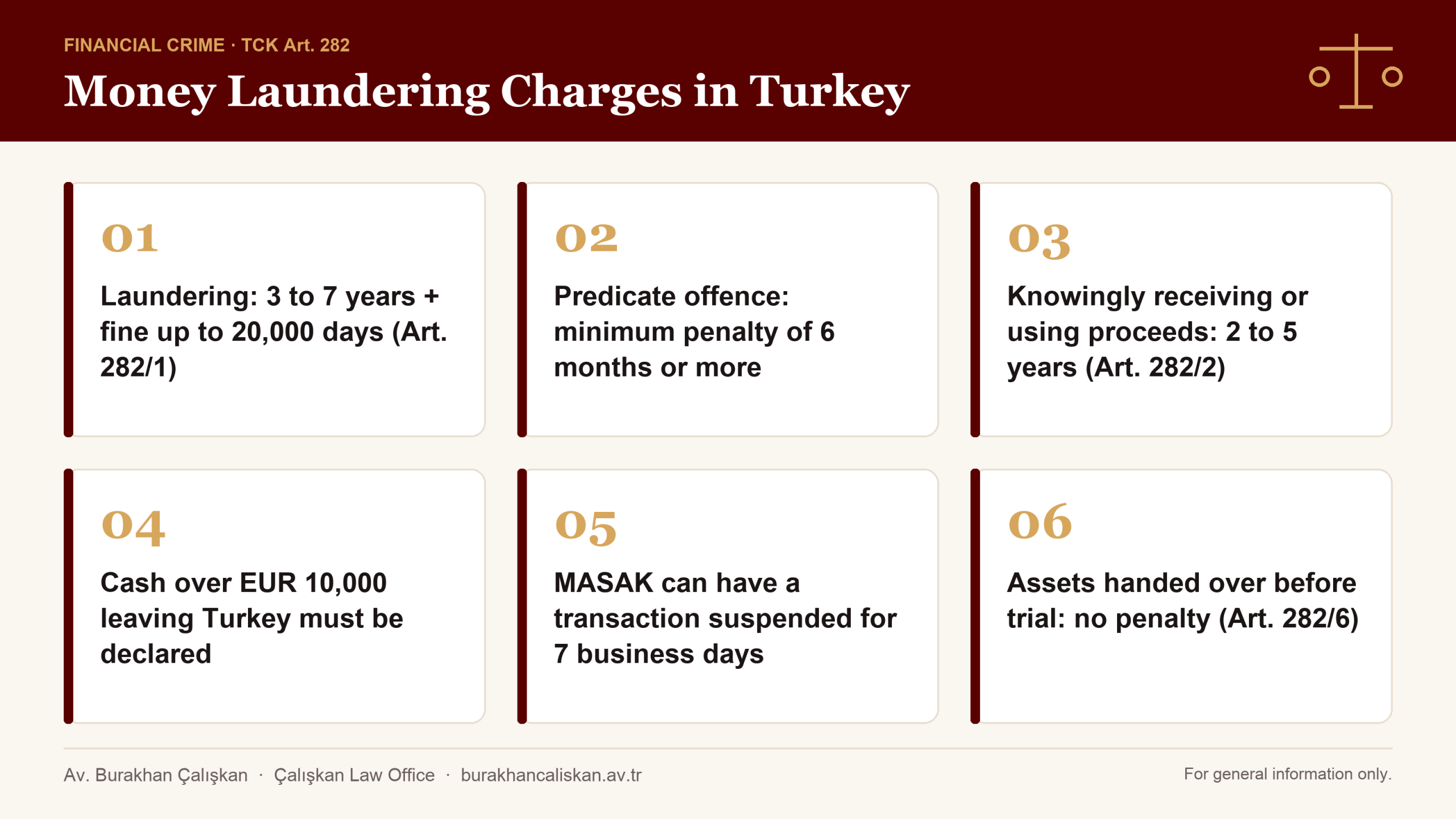
- Article 282/1 carries 3 to 7 years in prison plus a judicial fine of up to 20,000 days.
- The money must come from an offence with a minimum penalty of at least six months.
- Knowingly accepting, holding or using such assets is a separate offence (2 to 5 years).
- Undeclared cash at the border is normally an administrative matter, not laundering.
- Handing over the assets before the trial starts removes the penalty under Article 282/6.
Foreign nationals usually meet this offence through cash carried at an airport, crypto moved through an exchange, or a bank transfer from abroad. This guide explains each situation and what the Court of Cassation (Yargıtay) requires for a conviction.
A transaction can be suspended for seven business days, then seized. To get information about your case, you can call or send a WhatsApp message.
What is money laundering under Turkish law?
Money laundering, in Turkish law “laundering of asset values derived from crime” (suçtan kaynaklanan malvarlığı değerlerini aklama), is the offence of taking criminal proceeds abroad or transacting with them to hide their illegal source or make them look lawful. It is defined in Article 282 of the Turkish Penal Code (Turkish).
“A person who takes abroad asset values derived from an offence punishable by a minimum of six months’ imprisonment or more, or who subjects them to various transactions in order to conceal their illegitimate source or to give the impression that they were obtained lawfully, shall be punished with imprisonment from three years to seven years and a judicial fine of up to twenty thousand days.” (TCK Article 282/1, unofficial translation)
What is the penalty for money laundering in Turkey?
The penalty for money laundering in Turkey is imprisonment from three to seven years together with a judicial fine of up to 20,000 days under TCK Article 282/1. The prison term rises by one half for public officials and certain professionals, and is doubled within a criminal organisation.
Worked example: a judicial fine is the number of days multiplied by a daily amount of 100 to 500 Turkish lira (TCK Article 52/2); at the 20,000-day ceiling that is 2,000,000 to 10,000,000 lira. The three-year minimum, reduced by up to one sixth (TCK Article 62), gives 2 years and 6 months, above the two-year limit for suspension (TCK Article 51). Proceeds are confiscated under TCK Articles 54 and 55.
What counts as a predicate offence?
A predicate offence (öncül suç) is the earlier crime that produced the money. Under Article 282/1 it can be any offence whose minimum penalty is six months in prison or more. Fraud, drug trafficking, theft and breach of trust are typical examples.
For foreigners the usual link is to drug trafficking charges in Turkey or to fraud files in which accounts were used to move victims’ money.
After a retrial following a Constitutional Court ruling, the trial court acquitted the defendants of laundering. The Chamber stated that laundering requires a predicate offence but is a separate, independent offence. It quashed the acquittals because the earlier fraud, tax and forgery files, their dates and the causal link to the assets had not been examined.
Can you be charged for only receiving or holding the money?
Yes. Under TCK Article 282/2, a person who did not take part in the laundering but buys, accepts, holds or uses the proceeds while knowing where they come from faces two to five years in prison. Knowledge of the criminal origin is the decisive element.
Spending one’s own criminal proceeds, however, is not automatically laundering.
A defendant was convicted of breach of trust and of laundering. A MASAK report said he had “probably” passed proceeds to his father and father-in-law. The Chamber held that buying a car with the proceeds and keeping it in his own name is not laundering, although confiscation is possible, and quashed the conviction for lack of a detailed expert investigation of the relatives’ assets and income.
How is cash carried through a Turkish airport treated?
Cash carried through a Turkish airport is lawful in itself. Decree No. 32 on the Protection of the Value of Turkish Currency (Turkish) states that bringing foreign currency in and taking it out is free. Taking out more than 10,000 euros or its equivalent in cash, or more than 185,000 Turkish lira, is subject to a declaration procedure (Articles 3/d and 4/f).
Under Article 16 of Law No. 5549, passengers must give customs a full and accurate explanation when asked. Otherwise customs retains the money, imposes an administrative fine of one tenth of the amount carried (or of the undeclared difference) and reports the case to the Financial Crimes Investigation Board (MASAK).
None of this is laundering on its own; Article 282/1 applies only where the cash is suspected to come from a crime. See undeclared cash, foreign currency and gold at Turkish customs (in Turkish) and what happens after an arrest at Istanbul Airport.
Are crypto transfers treated as money laundering in Turkey?
Crypto transfers are treated like any other asset movement: they are lawful unless the assets come from a crime. Article 282 does not mention crypto, but its term “asset values” is broad. Since 2024 the Capital Markets Law No. 6362 defines crypto assets and regulates the platforms that trade and store them.
- Crypto asset service providers need permission from the Capital Markets Board (Article 35/B, added by Law No. 7518).
- Foreign platforms that target residents of Turkey, for example with a Turkish website, count as unlicensed (Article 99/A).
- Operating without a licence carries three to five years in prison and a fine of 5,000 to 10,000 days (Article 109/A).
For a customer the real risk is money received from strangers, converted into crypto and sent on.
What happens when a foreign bank transfer is flagged?
When a transfer from abroad looks unusual, the Turkish bank must report it to MASAK as a suspicious transaction under Article 4 of Law No. 5549 on the Prevention of Laundering Proceeds of Crime (Turkish). The bank may not tell the customer. The file can then move to a suspension, a seizure and a criminal investigation.
FROM A FLAGGED TRANSFER TO A COURT CASE
Documents explaining the transfer matter most: contracts, invoices, payslips, a sale deed. See what to do when MASAK examines money received in your account (in Turkish).
How does a money laundering investigation proceed for a foreigner?
A money laundering investigation in Turkey is run by the public prosecutor (Cumhuriyet savcısı), working with MASAK and the police. The suspect gives a statement with a lawyer and, if needed, an interpreter. The prosecutor may then ask a criminal judgeship of peace (sulh ceza hâkimliği) for detention or judicial control.
Laundering is not among the catalogue offences of Article 100/3 of the Code of Criminal Procedure (Turkish) (CMK), so pre-trial detention needs strong suspicion plus a ground such as a risk of flight. The lighter alternative is judicial control (adli kontrol), including a ban on leaving the country (CMK Article 109/3-a).
The basic offence is tried by a criminal court of first instance (asliye ceza mahkemesi). The limitation period is fifteen years for Article 282/1 and eight years for Article 282/2 (TCK Article 66).
If another state is also seeking the person, see extradition from Turkey and Interpol red notices.
What must the prosecution prove for a conviction?
For a conviction under Article 282, the prosecution must prove a predicate offence, that the assets came from it, a laundering act such as taking the assets abroad or a concealing transaction, and that the defendant knew the criminal origin. A sudden rise in wealth is not enough by itself.
A regional court of appeal convicted a defendant of laundering the proceeds of a theft and confiscated vehicles and a share in land. The Chamber quashed the conviction because the judgment did not state, beyond doubt, which transactions the proceeds had been put through; confiscation of the 60,000 lira belonged to the theft case.
Does handing over the assets remove the penalty?
Yes, if it is done in time. Article 282/6 provides that no penalty is imposed on a person who, before the prosecution phase begins, enables the authorities to seize the assets or reports where they are and so makes the seizure easier. The provision is known as effective remorse (etkin pişmanlık).
The exemption covers the laundering offence only; it does not remove liability for the predicate offence.
Common mistakes
Common mistakes in money laundering files are made in the first days, before the suspect understands what is being investigated. They concern unprepared statements, undocumented transfers and moving assets after a freeze.
- Giving a statement without knowing which transactions are questioned.
- Letting a friend or online contact use a bank or exchange account “as a favour”.
- Giving customs a vague answer or a lower figure about cash.
- Moving assets after a seizure order; such transactions are invalid (CMK Article 128/5).
- Waiting until the trial has started and missing effective remorse.
More guides for foreign nationals are collected under Criminal Law in Turkey.
Frequently Asked Questions
Is carrying a large amount of cash into Turkey a crime?
No. Decree No. 32 allows foreign currency to be brought in. The traveller must answer customs questions accurately (Law No. 5549, Article 16). Cash becomes a criminal matter only when it comes from a crime.
How many years in prison does money laundering carry in Turkey?
Article 282/1 carries three to seven years in prison and a judicial fine of up to 20,000 days. Knowingly receiving or using the proceeds carries two to five years under Article 282/2.
Can I be convicted of laundering if nobody was convicted of the first crime?
Laundering is a separate offence, but the court must still establish that a predicate offence was committed and that the assets came from it.
My Turkish bank account was frozen after a transfer from abroad. What does it mean?
Usually a suspension for seven business days (Law No. 5549, Article 19/A) or a seizure ordered by a judge (Article 17).
Is using a foreign crypto exchange from Turkey a crime for the customer?
Article 109/A of the Capital Markets Law punishes operating an unlicensed platform, not being a customer. A customer faces Article 282 only if the assets come from a crime.
Can a foreigner leave Turkey during a money laundering investigation?
Only if no ban on leaving the country has been imposed as judicial control under CMK Article 109/3-a, or after the ban has been lifted.
Bank records, customs reports and exchange statements are read together. To get information about your case, you can call +90 506 976 23 55 or send a WhatsApp message.
About the Author
Av. Burakhan Çalışkan is a lawyer at Çalışkan Hukuk Bürosu in Kartal, Istanbul, working in criminal law. His practice includes files in which bank accounts, cash movements and crypto transactions are examined under Article 282 of the Turkish Penal Code and Law No. 5549, among them cases of foreign nationals facing account seizures, customs retention of cash and travel bans.
Legal disclaimer: This article has been prepared for general information purposes only, based on current legislation and court decisions. The assessments it contains are general explanations that may vary according to the specific circumstances of each case; they do not constitute legal advice and do not create a lawyer-client relationship. As legislation and case law may change over time, it is recommended that you consult a qualified lawyer before taking any step regarding a specific legal problem.