Short answer: Carrying a knife in Turkey is legal only if the knife is an ordinary tool. Law No. 6136 prohibits carrying switchblades, daggers, swords and similar weapons, with six months to one year in prison. Carrying a firearm without a Turkish licence carries two to four years. Foreign licences are not recognised.
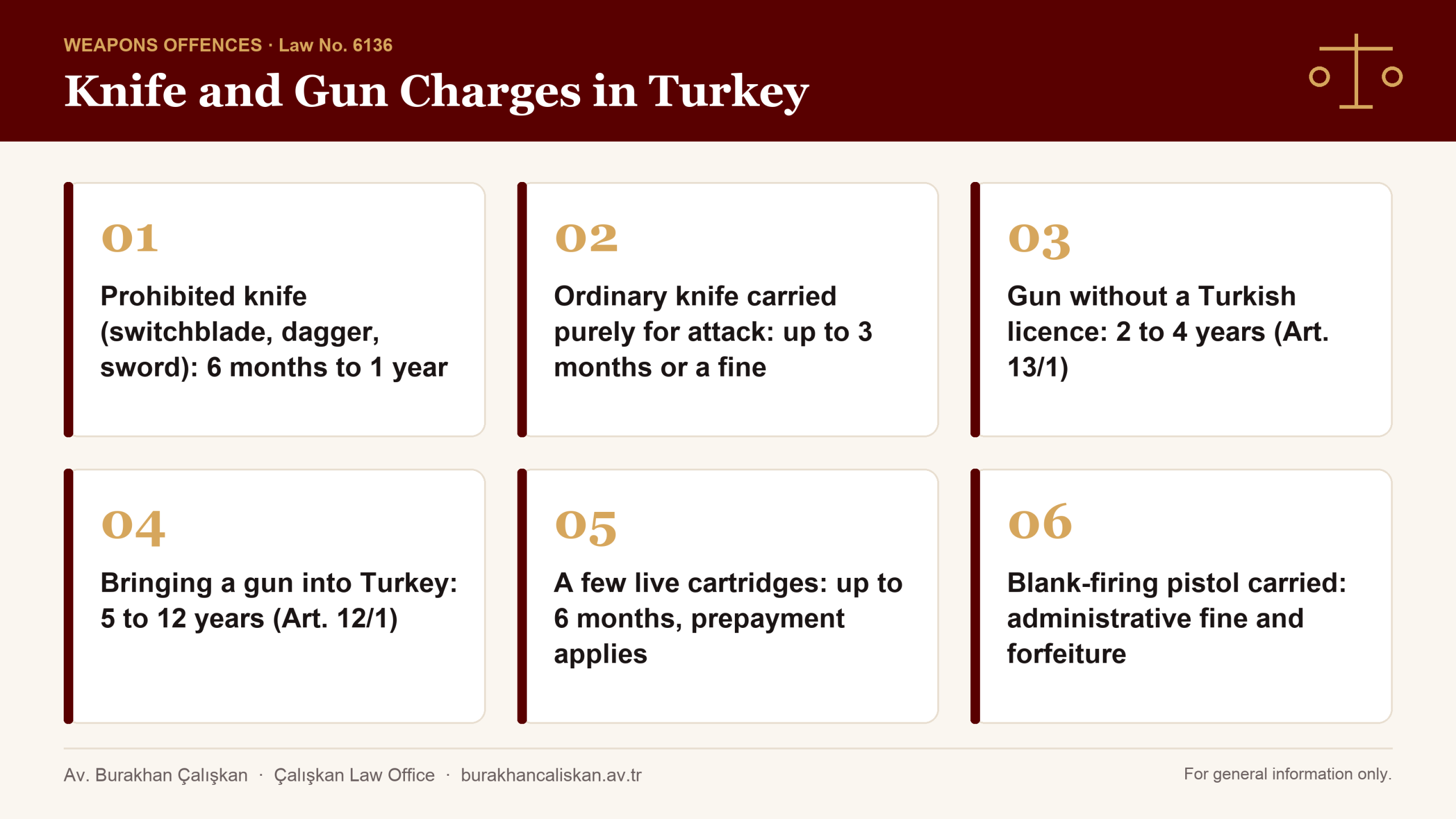
- Carrying a prohibited knife (switchblade, dagger, sword, knuckleduster) carries 6 months to 1 year in prison.
- An ordinary knife is punishable only if it is carried purely for attack (up to 3 months or a fine).
- Carrying a gun without a Turkish licence carries 2 to 4 years; bringing one into Turkey carries 5 to 12 years.
- A few live cartridges in luggage are an offence; a carried blank-firing pistol brings an administrative fine.
The offer of fast-track procedure or prepayment comes early and has short time limits. To get information about your case, you can call or send a WhatsApp message.
Is carrying a knife in Turkey legal?
Carrying a knife in Turkey is legal when the knife is a household, professional, agricultural or sporting tool and is carried for that use. Carrying a knife listed as prohibited in Article 4 of Law No. 6136 on Firearms, Knives and Other Instruments (Turkish) is a criminal offence, whatever the reason and whatever the blade length.
A weapons offence under Law No. 6136 is the offence of buying, carrying or possessing a firearm, cartridge or prohibited knife contrary to that Law. It is a crime, not an administrative matter, whatever the nationality.
Which knives are prohibited under Law No. 6136?
Article 4/1 of Law No. 6136 lists the prohibited knives and instruments by name: daggers, switchblades, sword canes, machetes, swords, bayonets, pointed and grooved knives, maces, weighted whips, garrotte wires or chains, knuckledusters, and similar instruments made purely for attack and defence. Article 5 prohibits selling, buying, carrying and possessing them.
“The use of instruments which are household utensils or are used for medicine, industry, agriculture or sport, and of knives, skewers, rasps and the like which are necessary for practising a profession or craft, is not subject to the provisions of this Law.” (Law No. 6136, Article 4/3, unofficial translation, extract)
Whether a knife is on the list is decided by a criminal laboratory report.
A man was fined under Article 15/4 for a knife the police record called a switchblade. The Chamber held that a laboratory report had to establish whether the spring catch and lock worked, and so whether the knife was prohibited. It added that Article 15/4 cannot be applied on top of convictions for an injury and a threat committed with the same knife.
What is the penalty for carrying a prohibited knife?
The penalty for buying, carrying or possessing a prohibited knife is imprisonment from six months to one year and a judicial fine of at least 25 days under Article 15/1 of Law No. 6136. The penalty is increased by one half to double where the knives are grave in number or nature (Article 15/2).
Worked example: a tourist is found with one switchblade. The minimum under Article 15/1 is six months. Under the fast-track procedure it is halved to three months, which the prosecutor may convert into a fine or suspend (CMK Article 250/5). The knife is confiscated (TCK Article 54/4).
Can an ordinary knife still lead to charges?
Yes. Under Article 15/4 of Law No. 6136, a person who carries an ordinary knife or tool purely in order to use it in an attack, judged by the circumstances, faces up to three months in prison or a judicial fine. That purpose must be proved; carrying alone is not enough.
Under Article 6/1-f of the Turkish Penal Code (Turkish) (TCK), any cutting or piercing instrument fit for attack counts as a weapon. Intentional injury with a weapon is increased by one half (TCK Article 86/3-e), and a threat with a weapon carries two to seven years (TCK Article 106/2-a). See assault charges in Turkey after a bar fight and whether carrying a knife is an offence (in Turkish).
Where the threat is directed at a spouse or partner, a protection order can follow as well; see domestic violence and protection orders in Turkey.
What is the penalty for carrying a gun without a Turkish licence?
Carrying, buying or possessing a firearm without a Turkish licence is punished with two to four years in prison and a judicial fine of 100 to 500 days under Article 13/1 of Law No. 6136. The same penalty covers a blank-firing pistol converted to fire live ammunition.
Rifles, fully automatic weapons and guns with silencers or scopes carry five to eight years (Article 13/2).
A foreign licence has no effect: the Law recognises only permits issued under its own provisions. See the penalty for an unlicensed firearm (in Turkish).
Can a foreigner bring a firearm into Turkey?
A foreigner can bring a firearm into Turkey only in the narrow cases the Law lists. Under Additional Article 4 of Law No. 6136, foreigners arriving to hunt with a permit or to take part in shooting competitions may bring their guns temporarily, on condition that they declare them to customs and obtain permission from the police at the border gate; the guns are recorded in the passport.
Outside these routes, bringing a firearm or cartridges into Turkey, or attempting to, is weapons smuggling under Article 12/1: five to twelve years in prison. It is also a catalogue offence for pre-trial detention under Article 100/3-b of the Code of Criminal Procedure (Turkish) (CMK).
What happens if a bullet or knife is found at a Turkish airport?
When an X-ray operator at a Turkish airport sees a cartridge, knife or gun, the airport police seize the item, draw up a record and inform the public prosecutor (Cumhuriyet savcısı). The item goes to a criminal laboratory, and the traveller gives a statement, with a lawyer and an interpreter if needed.
At İzmir Adnan Menderes Airport, one 7.65 mm cartridge was found in a passenger’s wallet. The trial court acquitted him for lack of intent. The Chamber quashed the acquittal: the act fell under Article 13/4, and prepayment had to be applied. It referred to its practice of applying Article 13/4 to 50 or fewer cartridges kept at home or work, Article 13/3 to 51 to 250, and Article 13/1 to 251 or more.
See also what happens after an arrest at Istanbul Airport.
Are blank-firing pistols legal in Turkey?
Blank-firing pistols (kurusıkı) are legal to own but not to carry. Law No. 5729 on Sound and Gas Cartridge Guns (Turkish) prohibits carrying them (Article 3/1-a) and allows transport only unloaded, in a box. A breach leads to an administrative fine and forfeiture of the pistol (Article 4).
Firing a blank pistol in a way that endangers people or causes panic is a crime: six months to three years, increased by one half in crowded places (TCK Article 170). Converting it to fire live rounds is treated as unlawful manufacture of a firearm (Law No. 6136, Article 12).
A blank-firing pistol, its cartridges and three live cartridges were found in a car, and the driver was sentenced under Article 13/1. The Chamber held that the blank pistol and its cartridges are outside Law No. 6136; only the three live cartridges counted, under Article 13/4, with prepayment offered first.
How does a weapons case proceed for a foreigner?
A weapons case in Turkey starts with seizure and a police record and is run by the public prosecutor. Police custody (gözaltı) lasts at most 24 hours for an individual offence (CMK Article 91/1). Most knife and cartridge files end without a full trial, through prepayment or the fast-track procedure.
FROM SEIZURE TO JUDGMENT
The fast-track procedure is not applied when the suspect is abroad (CMK Article 250/13), so a foreigner who leaves before the offer loses the reduction.
Pre-trial detention is excluded for Article 15/1, because its upper limit does not exceed two years (CMK Article 100/4). It is possible for Articles 13/1 and 12. The alternative is judicial control (adli kontrol), including a ban on leaving the country (CMK Article 109/3-a); see travel bans on foreigners in Turkish criminal cases.
Common mistakes
Common mistakes in weapons files are made before the suspect knows which article applies. Most concern the first statement, the laboratory report and the short time limits for prepayment and the fast-track offer.
- Assuming that a knife sold openly in a bazaar is legal to carry.
- Saying the knife or gun was carried “for protection”; this can supply the purpose required by Article 15/4.
- Leaving Turkey before the fast-track offer and losing the reduction by one half.
More guides for foreign nationals are collected under Criminal Law in Turkey.
Frequently Asked Questions
The questions below are the ones foreign visitors and residents ask most often about knives, guns, cartridges and blank-firing pistols in Turkey. Each answer states the rule and the article it rests on.
Is it legal to carry a pocket knife in Turkey?
An ordinary folding pocket knife is not on the prohibited list in Article 4 of Law No. 6136. Carrying it is an offence only if it is carried purely for attack (Article 15/4). Switchblades are prohibited outright.
Can I bring a knife bought as a souvenir home from Turkey?
A kitchen or craft knife is outside Law No. 6136 (Article 4/3). A dagger, sword, switchblade or sword cane is prohibited: buying or carrying it carries six months to one year under Article 15/1.
Is my foreign gun licence valid in Turkey?
No. Law No. 6136 recognises only permits issued under Turkish law. Under Additional Article 4, visiting hunters and competition shooters may bring declared guns in with a border police permit.
What happens if one bullet is found in my bag at a Turkish airport?
It falls under Article 13/4 of Law No. 6136: up to six months in prison and a judicial fine. Because the upper limit is six months, prepayment under TCK Article 75 must be offered first.
Are blank-firing pistols legal to carry in Turkey?
No. Law No. 5729 prohibits carrying them; the sanction is an administrative fine and forfeiture, not prison. Firing one in a way that endangers people carries six months to three years (TCK Article 170/1).
Can I be held in prison before trial for carrying a knife?
Not for the carrying alone. CMK Article 100/4 bars pre-trial detention where the upper limit does not exceed two years; Article 15/1 stops at one year. A ban on leaving Turkey remains possible.
The laboratory report, the seizure record and the article applied are read together. To get information about your case, you can call +90 506 976 23 55 or send a WhatsApp message.
About the Author
Av. Burakhan Çalışkan is a lawyer at Çalışkan Hukuk Bürosu in Kartal, Istanbul, working in criminal law. His practice includes investigation and trial files under Law No. 6136 on firearms, knives and cartridges, among them cases of foreign nationals stopped at airports or searched in the street in Istanbul, and the prepayment, fast-track and judicial control stages that follow in such investigations.
Legal disclaimer: This article has been prepared for general information purposes only, based on current legislation and court decisions. The assessments it contains are general explanations that may vary according to the specific circumstances of each case; they do not constitute legal advice and do not create a lawyer-client relationship. As legislation and case law may change over time, it is recommended that you consult a qualified lawyer before taking any step regarding a specific legal problem.