Short answer: Taking antiquities, old coins or historic stones out of Turkey without permission is a serious crime. Article 68 of Law No. 2863 punishes anyone who takes protected cultural property abroad with 5 to 12 years in prison and a judicial fine of up to 5,000 days. Tourists are usually stopped at airport security, and the case then turns on a museum expert report and on whether the traveller knew what the item was.
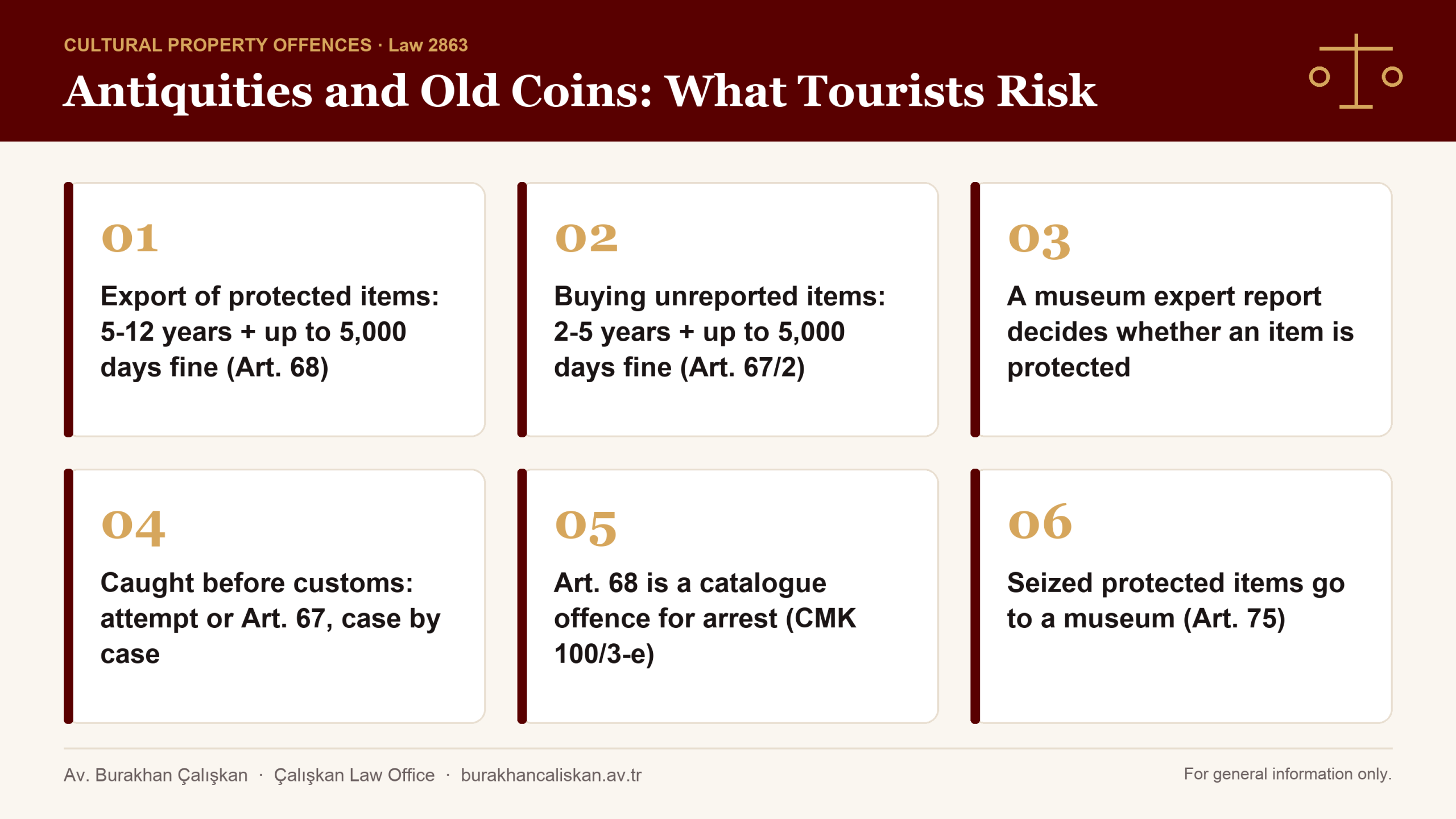
- Taking protected cultural property out of Turkey carries 5 to 12 years in prison under Article 68 of Law No. 2863.
- Old coins, carved stones and figurines can all be protected; a museum expert report decides each item.
- Buying an unreported protected item is a separate crime under Article 67/2 (2 to 5 years).
- A traveller who truly did not know the item was an antiquity lacks intent, but courts test that claim.
- Pre-trial detention is possible, and a ban on leaving Turkey is a common alternative.
Foreign visitors can face arrest in Turkey over antiquities bought as souvenirs or picked up at an ancient site. This guide explains the offences, the airport procedure, detention and how the Court of Cassation (Yargıtay) treats the souvenir defence.
The first statement and expert report shape the case. To get information about your case, you can call or send a WhatsApp message.
What counts as an antiquity or protected cultural property in Turkey?
Protected cultural property (kültür varlığı) is, under Article 3 of Law No. 2863, any movable or immovable item from prehistoric or historic periods relating to science, culture, religion or fine arts, or with original scientific and cultural value. Article 23 then lists the movable items that must be protected.
The list includes coins (sikkeler), seals, figurines, statues, ceramics, jewellery, manuscripts, icons and their pieces, plus ethnographic objects. Late Ottoman coins (Abdülmecit to Vahidettin) and certain ethnographic items may be traded inside Turkey, but neither rule allows taking them abroad. Read Law No. 2863 on the Protection of Cultural and Natural Property (Turkish).
Is it a crime to take old coins or stones out of Turkey?
Yes. Taking old coins or historic stones out of Turkey is a crime whenever they qualify as protected cultural property. Article 32 of Law No. 2863 bans taking protected movable cultural and natural property abroad, apart from approved temporary exhibitions, and Article 68 attaches the criminal penalty.
One coin or carved fragment is enough. Modern replicas are not cultural property, but the expert, not the seller, decides what is a replica.
What is the penalty under Article 68 of Law No. 2863?
Article 68 of Law No. 2863 punishes a person who takes cultural or natural property abroad in breach of the law with imprisonment from five to twelve years and a judicial fine of up to five thousand days. Neighbouring articles cover buying, failing to report and trading protected items, with lighter penalties.
“A person who takes cultural and natural property abroad in breach of this Law shall be punished with imprisonment from five to twelve years and a judicial fine of up to five thousand days.” (Law No. 2863, Article 68, unofficial translation)
Worked example: an attempt is reduced by one quarter to three quarters (Turkish Penal Code, TCK Article 35/2), and TCK Article 62 allows a further discretionary reduction of up to one sixth. From the 5-year minimum (60 months), a three-quarter reduction leaves 15 months, and one sixth less gives 1 year and 15 days. At two years or less, suspension (TCK Article 51) or deferral of the verdict (CMK Article 231/5) can be considered; a half reduction gives 2 years and 1 month, closing those options.
What if you bought the item at a shop or bazaar as a souvenir?
Buying an item in a shop, bazaar or from a street vendor does not make it legal to export. If the item is protected and unreported, buying it can itself be an offence under Article 67/2. The real defence question is intent: whether the traveller knew, or must have known, that the object was a genuine antiquity.
Under TCK Article 30/1, a person who does not know the material elements of an offence does not act with intent. Two Court of Cassation judgments show both sides.
A traveller convicted under Article 68/1 and TCK Article 35/2 over a protected marble stone said throughout that he had bought it from a street vendor during the trip and did not know it was historic. The Chamber quashed the conviction because no evidence contradicted this defence. It also faulted the refusal to suspend the sentence.
At the international departures entrance of Atatürk Airport, ten items were found in a passenger’s luggage; a Topkapı Palace Museum report said they could not leave Turkey. He said he bought them as gifts near the Grand Bazaar, but they looked old and he could not identify the seller. The Chamber treated the act as attempted export and quashed the acquittal.
A traceable seller and a mass-produced look help; an obviously ancient object from an unknown seller hurts. For Turkish-language background, see antiquities smuggling penalties (in Turkish) and whether selling old coins is a crime (in Turkish).
What happens when antiquities are found at the airport?
When antiquities are found at a Turkish airport, police seize and record the items and inform the public prosecutor (Cumhuriyet savcısı). A museum expert examines them, the suspect gives a statement with a lawyer and an interpreter, and the prosecutor decides whether to request detention or judicial control.
FROM THE AIRPORT X-RAY TO THE COURTROOM
A foreign suspect can ask for an interpreter, a lawyer and for the consulate to be informed. See what happens after an arrest at Istanbul Airport and how a criminal case works in Turkey.
Is it smuggling or only an attempt if you are stopped before customs?
Whether a traveller stopped at the airport has attempted smuggling depends on where the items were found. Court of Cassation judgments have not been uniform: the 2014 judgment above treated a seizure at a departures entrance as an attempt, while a more recent line asks whether the customs line had been reached.
Books, some protected under Law No. 2863, were found at the x-ray at an international terminal entrance. Following a 2023 judgment of the same Chamber, the trial court held that outside the customs line the person could still change his mind, so there was no attempted smuggling, though Article 67 could apply. The case was dropped for limitation, the items went to a museum, and the Chamber upheld the judgment.
The police record should therefore state exactly where the items were found.
How does the museum expert report decide the case?
The museum expert report decides whether the seized item is protected cultural property at all, which is the starting point of every antiquities case in Turkey. Museum staff date and describe the item and state whether it falls under Law No. 2863. Without that finding, no offence under this law exists.
The defence can ask for an independent panel of university archaeologists or art historians, especially when the report is brief or inconsistent. Under Article 75, protected items seized in such cases are handed to a museum.
Can a tourist be arrested or banned from leaving Turkey?
Yes. A tourist suspected of antiquities smuggling can be detained pending trial or banned from leaving Turkey. Under CMK Article 100/3-e, strong suspicion of the Article 68 or Article 74 offences of Law No. 2863 can itself be treated as a ground for pre-trial detention (tutuklama).
Detention still requires concrete evidence and proportionality (CMK Article 100/1); judicial control (adli kontrol), usually a travel ban under Article 109/3-a, is the alternative. Read the Code of Criminal Procedure (Turkish) and our guide to travel bans on foreigners in a Turkish criminal case.
How can you legally take antiques or souvenirs home?
The safest way to take souvenirs home from Turkey is to buy modern items with an invoice, avoid anything that looks ancient, and have doubtful objects checked before travelling. Article 24 of Law No. 2863 provides that such items to be taken abroad can be checked by Ministry museums or specialist staff at certain customs exits.
If the check finds an item should not leave Turkey, it is returned to its owner on condition that it stays in the country. Confirm the current procedure with the museum directorate; a receipt is not an export permit.
Common mistakes
Most antiquities cases involving tourists in Turkey grow out of a few avoidable mistakes made before or right after the airport search. These patterns appear most often in the files of foreign travellers:
- Treating a receipt or the seller’s word as proof that an item is a replica.
- Picking up a coin or carved fragment at an ancient site as a keepsake.
- Giving a detailed statement without a lawyer or proper interpreter.
- Not asking for an independent expert panel when the museum report is weak.
- Leaving Turkey without checking for a travel ban or leaving no address for notices.
More guides for foreign nationals are collected under Criminal Law in Turkey.
Frequently Asked Questions
Can I take a coin I bought at the Grand Bazaar out of Turkey?
Only if it is not protected cultural property. Coins are listed in Article 23 of Law No. 2863, and Article 32 bans taking protected movable items abroad. A shop receipt does not decide this; a museum expert does.
Is a stone or marble piece from a beach or ruin a problem?
It can be. Ordinary pebbles are generally not cultural property, but a carved, inscribed or worked piece taken from an ancient site can be, and rare fossils can be protected natural property.
Will I be arrested if old coins are found in my luggage?
Not automatically. The prosecutor decides whether to ask a criminal judgeship of peace for pre-trial detention or judicial control. Article 68 is listed in CMK Article 100/3-e, so detention is possible, but a ban on leaving Turkey is a common lighter alternative.
How long does an antiquities case take in Turkey?
The law sets no fixed duration. Expert reports, translation, the trial and any appeal all take time. One 2025 case ended only when the limitation period expired.
Do I get my items back if they are not antiquities?
If the expert finds an item is a modern copy or outside Law No. 2863, it is not cultural property and the offence fails for that item. Protected items seized in the case are handed to a museum under Article 75, even when no conviction follows.
Can a foreigner leave Turkey while the case continues?
Only if no travel ban under CMK Article 109/3-a has been imposed, or after it is lifted. A suspect who leaves should give a reliable address for court notices.
The expert report and any travel ban can be reviewed together. To get information about your case, you can call or send a WhatsApp message.
About the Author
Av. Burakhan Çalışkan is a lawyer at Çalışkan Hukuk Bürosu in Kartal, Istanbul, working in criminal law. His practice includes files of foreign nationals stopped at Turkish airports, where cultural property charges under Law No. 2863 raise questions about museum expert reports, the place of seizure, detention and travel bans, often followed together with families abroad.
Legal disclaimer: This article has been prepared for general information purposes only, based on current legislation and established legal practice. The assessments it contains are general explanations that may vary according to the specific circumstances of each case; they do not constitute legal advice and do not create a lawyer-client relationship. As legislation and case law may change over time, it is recommended that you consult a qualified lawyer before taking any step regarding a specific legal problem.