Short answer: The fake passport Turkey penalty is two to five years in prison. Under Article 204/1 of the Turkish Penal Code (TCK), a person who forges an official document, alters a genuine one or uses a forged one is punished with that sentence. A forged visa sticker, residence permit or border stamp is treated the same way, and deportation with an entry ban usually follows.
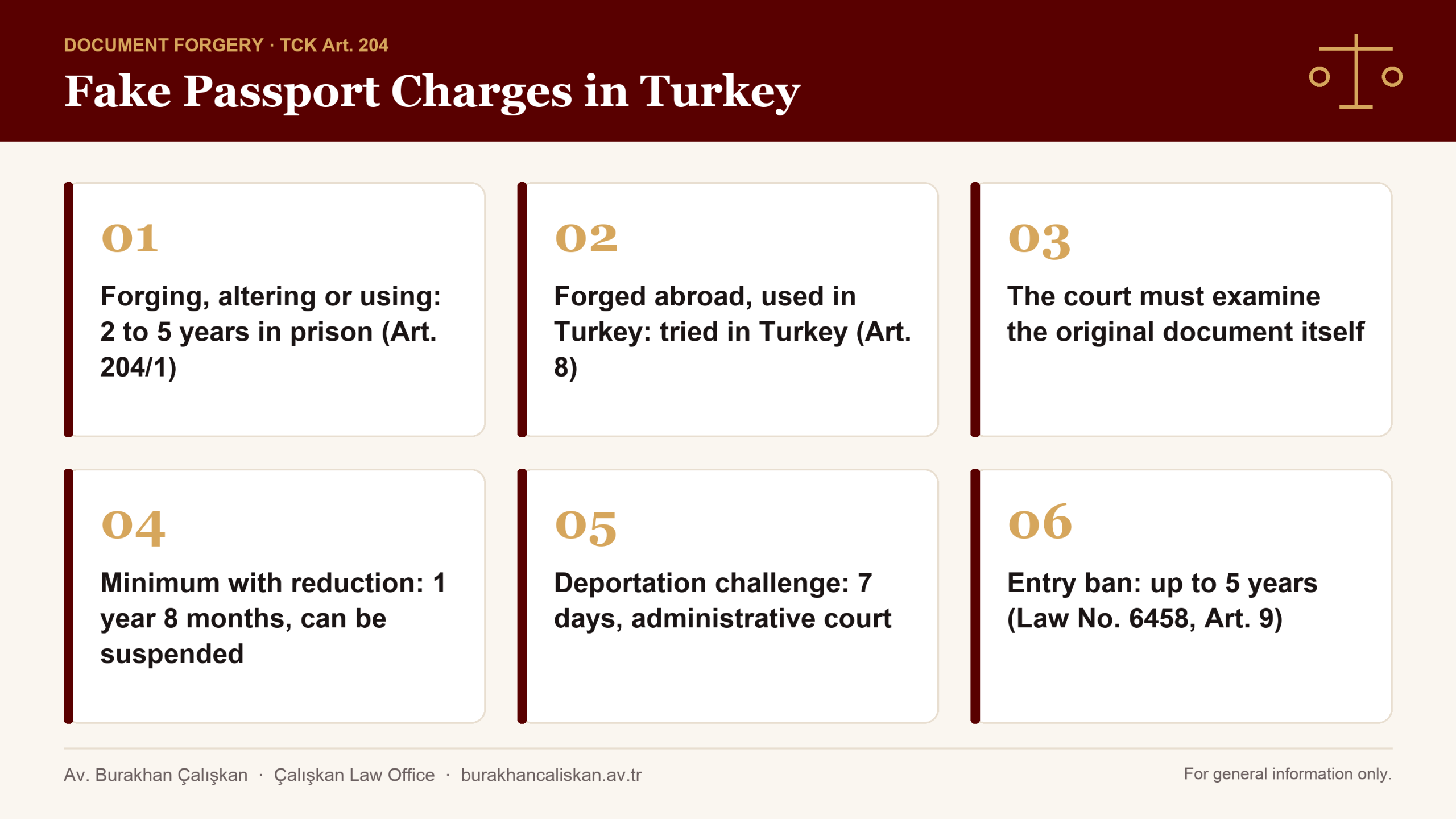
- Making, altering or using a forged passport, visa or residence permit carries 2 to 5 years in prison (Article 204/1).
- Using the document in Turkey is enough; it does not matter that it was forged abroad.
- A forged document also leads to deportation and an entry ban of up to five years.
- A deportation decision must be challenged within seven days.
Most foreigners meet this charge at passport control: at an airport on the way to Europe, at a land border, or after being sent back by another country. This guide explains the offence, the procedure and the immigration consequences.
A deportation decision can be challenged only within seven days of notification. To get information about your case, you can call or send a WhatsApp message.
Is using a fake passport a crime in Turkey?
Yes. Forgery of an official document (resmî belgede sahtecilik) is the offence of making a false official document, altering a genuine one in a way that deceives others, or using a forged one. It is defined in Article 204 of the Turkish Penal Code (Turkish).
“A person who forges an official document, alters a genuine official document in a way that deceives others, or uses a forged official document shall be punished with imprisonment from two years to five years.” (TCK Article 204/1, unofficial translation)
The three acts are alternatives: a traveller who hands a forged passport to a border officer commits the offence by using it. Under TCK Article 8, an offence committed partly in Turkey counts as committed in Turkey, so a passport forged abroad and shown at a Turkish gate is tried here.
What is the penalty for a fake passport, visa or residence permit?
The penalty for a fake passport, visa or residence permit in Turkey is imprisonment from two to five years under TCK Article 204/1. The booklet itself, a visa sticker inside it, a residence permit card and an entry-exit stamp are all treated as official documents.
Worked example: a court that starts from the two-year minimum and applies the discretionary reduction of up to one sixth (TCK Article 62) reaches 1 year and 8 months. A sentence of two years or less can be suspended (TCK Article 51), or its pronouncement can be deferred under Article 231 of the Code of Criminal Procedure (Turkish) (CMK) if the person has no earlier conviction for an intentional offence. The limitation period is eight years (TCK Article 66/1-e).
Does a forged foreign passport count as an official document?
Yes, in the judgments read for this article. The Court of Cassation (Yargıtay) applied Article 204/1 to a forged Israeli passport and to an altered Iranian passport in the same way as to Turkish documents. In the second case 2 years and 6 months was upheld (11th Criminal Chamber, judgment of 24.05.2023, E. 2019/7850, K. 2023/4372).
The defendant bought a forged Israeli passport in the Netherlands for 15,000 euros and used it to enter and leave Turkey twice before Hungary sent him back. The trial court increased the sentence for a continuing offence. The Chamber quashed the judgment: using the same forged passport more than once is not a continuing offence; it can only be weighed when the basic sentence is set.
What if I did not know the visa was fake?
Forgery under Article 204 is an intentional offence. A person who did not know that the visa or permit was forged does not commit it. Courts do not accept the claim on its face, however; they compare it with the price paid, the way the document was obtained and the person’s own conduct at the gate.
Details that can be checked support the defence: the agent’s name and phone number, payment records, messages.
Passengers leaving Antalya Airport for Switzerland were found to have forged Schengen visas in their passports. Relying on the examination reports and its own observation, the trial court imposed 1 year and 8 months each, suspended. The prosecutor appealed against the suspension; the Chamber upheld the judgment.
When is a forged document not punishable as forgery?
A forged document is punishable as forgery only if it is capable of deceiving an ordinary person, a quality Turkish courts call deceptive capacity (aldatma kabiliyeti). A crude alteration that anyone would notice at first glance does not meet the test. The judge decides this personally by examining the original document.
A passenger was returned from Vienna to Istanbul Sabiha Gökçen Airport as inadmissible. Austria kept the passport, so no expert report could be obtained. He confessed and was convicted. The Chamber quashed the conviction: the court had to bring the passport and the ticket bearing a forged exit stamp to the hearing and decide whether they could deceive. It added that 1 year and 8 months cannot be converted into a fine.
What happens after being caught at a Turkish airport?
A person caught with a suspected forged document at a Turkish airport is handed to the police, and the public prosecutor (Cumhuriyet savcısı) is informed. Police custody (gözaltı) may last up to 24 hours from the arrest, plus up to 12 hours for transport to the nearest judge (CMK Article 91/1).
FROM PASSPORT CONTROL TO THE COURTROOM
A lawyer is appointed on request. The steps are described in how a criminal case works in Turkey.
Can a foreigner be held in pre-trial detention for forgery?
Yes. Pre-trial detention (tutuklama) is possible for forgery of an official document because the maximum penalty of five years is above the two-year threshold in CMK Article 100/4. The judge needs concrete evidence of strong suspicion and a ground for detention, most often a risk of flight.
Article 204 is not a catalogue offence under CMK Article 100/3. The lighter alternative is judicial control (adli kontrol) under CMK Article 109, such as a ban on leaving the country. See travel bans imposed on foreigners during a criminal case.
Is giving false information to officials a separate offence?
Yes. A person who makes a false statement to a public official authorised to issue an official document commits a separate, lighter offence under TCK Article 206, punished with three months to two years in prison or a judicial fine. The lie itself is the offence.
- A job letter or lease filed with a residence permit application is a private document; forging and using it falls under Article 207.
- Using another person’s identity to avoid an investigation is punished under Article 268, by reference to the provisions on calumny.
- A forged document used while committing another offence leads to two separate penalties (Article 212).
Articles 206 and 268 are on the list of the fast-track procedure (seri muhakeme) in CMK Article 250: if the suspect accepts the prosecutor’s offer with a lawyer present, the sentence is halved. Article 204 is not on that list, nor open to mediation under CMK Article 253. For other forged papers see the penalty for a fake diploma (in Turkish).
Will I be deported and banned from Turkey?
In most cases, yes. Under Article 54/1-c of Law No. 6458 on Foreigners and International Protection (Turkish), a deportation decision is taken against foreigners who use false information or forged documents in procedures for entry, visas and residence permits. The governorate decides, separately from the criminal case.
- At the border: a foreigner whose passport, visa or permit proves to be forged is refused entry and sent back (Article 7/1-a).
- Removal centre: administrative detention for up to six months, extendable by six more; a criminal judge of peace decides a challenge within five days (Article 57).
- Court challenge: administrative court within seven days of notification; no removal during the proceedings, and the decision is final (Article 53/3).
- Entry ban: at most five years; up to ten more for a serious threat to public order or security (Article 9/3).
A foreigner sentenced to prison is also reported to the Ministry of Interior once the sentence is served (TCK Article 59). Details are in deportation and entry bans after a criminal case in Turkey.
Foreign spouses who are victims of violence are covered by separate residence rules; see domestic violence and protection orders in Turkey.
Common mistakes
Common mistakes in forged document files are made in the first 24 hours, when the person is tired, frightened and often without a trusted interpreter. They concern the first statement, the evidence about the agent and the short administrative time limits.
- Signing a statement without a lawyer or without understanding the translation.
- Naming the agent only at trial, when phone records and payments can no longer be traced.
- Giving a false name or nationality, which adds a second offence.
- Focusing on the criminal case and missing the seven-day limit against deportation.
More guides for foreign nationals are collected under Criminal Law in Turkey.
Frequently Asked Questions
How many years in prison does a fake passport carry in Turkey?
Two to five years in prison under Article 204/1 of the Turkish Penal Code. With the discretionary reduction of up to one sixth, the minimum becomes 1 year and 8 months, a sentence that can be suspended.
I paid an agent for a visa and did not know it was fake. Am I guilty?
Forgery is an intentional offence, so a person who truly did not know is not guilty. The court tests the claim against the price paid and the way the document was obtained.
The passport was forged abroad. Can Turkey still prosecute?
Yes. Showing the forged passport at a Turkish border gate is “using” it, and an offence committed partly in Turkey counts as committed in Turkey (Turkish Penal Code, Article 8).
Can the prison sentence be turned into a fine?
Only sentences of one year or less can be converted into a judicial fine (Turkish Penal Code, Articles 49/2 and 50). A sentence of up to two years can be suspended if the legal conditions are met.
Will I be deported after a forged document case?
A deportation decision is taken against foreigners who use forged documents in entry, visa or residence permit procedures (Law No. 6458, Article 54/1-c). It can be challenged before the administrative court within seven days.
How long is the entry ban after deportation?
At most five years. Where there is a serious threat to public order or public security, it may be extended by up to ten more years (Law No. 6458, Article 9/3).
The document report, the first statement and the deportation file are read together. To get information about your case, you can call +90 506 976 23 55 or send a WhatsApp message.
About the Author
Av. Burakhan Çalışkan is a lawyer at Çalışkan Hukuk Bürosu in Kartal, Istanbul, working in criminal law. His practice includes forgery files under Articles 204 to 212 of the Turkish Penal Code, among them cases of foreign nationals stopped at passport control with forged passports, visa stickers or residence permits, and the deportation proceedings under Law No. 6458 that run alongside them.
Legal disclaimer: This article has been prepared for general information purposes only, based on current legislation and court decisions. The assessments it contains are general explanations that may vary according to the specific circumstances of each case; they do not constitute legal advice and do not create a lawyer-client relationship. As legislation and case law may change over time, it is recommended that you consult a qualified lawyer before taking any step regarding a specific legal problem.