Short answer: A tourist involved in a bar fight in Turkey can be charged with intentional injury under Article 86 of the Turkish Penal Code. Police may hold the suspect for up to 24 hours. A minor injury carries 6 months to 1 year 6 months and needs the victim’s complaint; other injuries carry 1 year 6 months to 3 years. Bottles or glasses count as weapons and raise the penalty by half.
- Intentional injury under Article 86 of the Turkish Penal Code (TCK) carries 1 year 6 months to 3 years; a minor injury, 6 months to 1 year 6 months.
- A minor injury needs the victim’s complaint, and most assault files go to mediation first.
- A bottle, glass or chair counts as a weapon: the penalty rises by half and mediation is excluded.
- Self-defence leads to acquittal only if it is clear who attacked first and the response was proportionate.
- A foreign suspect may face a travel ban during the case and a deportation assessment after a prison sentence.
Assault charges in Turkey often start with seconds of trouble at a bar or club. This guide covers custody, the medical report, penalties, mediation, self-defence, travel bans and deportation.
Your statement, the medical report and any travel ban are decided in the first day. To get information about your case, you can call or send a WhatsApp message.
What happens after a bar fight in Turkey as a tourist?
After a bar fight in Turkey, police usually take everyone involved to the station, send the injured people to hospital for a forensic medical report (darp raporu) and inform the public prosecutor (Cumhuriyet savcısı). The prosecutor then decides whether to release the suspects, refer the file to mediation or bring them before a judge.
Intentional injury (kasten yaralama) is the offence of deliberately causing another person bodily pain or harming their health or perception. The Turkish Penal Code (TCK) and Code of Criminal Procedure (CMK) apply to tourists exactly as to residents.
WHAT HAPPENS AFTER A BAR FIGHT IN TURKEY
What is the penalty for assault under Article 86 of the Turkish Penal Code?
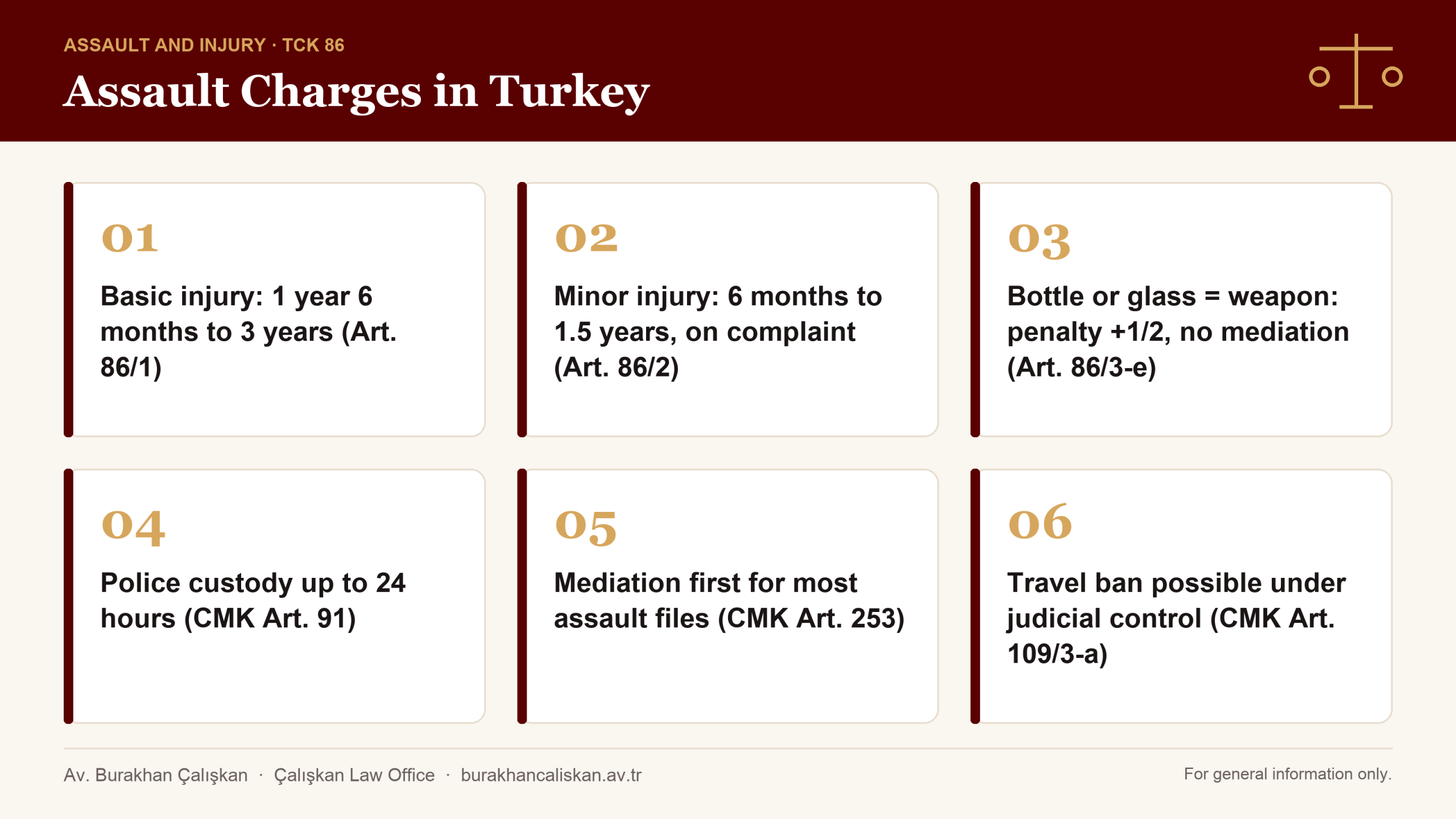
The penalty for assault in Turkey depends on the injury and the circumstances. Under Article 86/1 TCK, intentional injury carries 1 year 6 months to 3 years in prison. A minor injury curable with simple medical intervention carries 6 months to 1 year 6 months or a judicial fine (Article 86/2), and weapons raise the penalty by half (Article 86/3).
“Any person who intentionally causes another person bodily pain or impairs their health or perception shall be sentenced to imprisonment from one year six months to three years.” (Turkish Penal Code, Article 86/1, unofficial translation)
These ranges follow Law No. 7550 (Official Gazette, 4 June 2025), which raised the basic range of Article 86/1. For earlier incidents the more favourable version applies. Full text: Turkish Penal Code (Turkish).
Where the injured person is a spouse, the rules differ; see domestic violence and protection orders in Turkey.
Does being drunk reduce the penalty?
No. Under Article 34/2 TCK, voluntary intoxication does not remove or reduce responsibility. Only alcohol taken against one’s will, such as a spiked drink, can matter (Article 34/1).
When does a bottle or glass make it “assault with a weapon”?
A bottle, glass, ashtray or chair makes the offence assault with a weapon under Turkish law. Article 6/1-f TCK defines a weapon to include things not made for attack or defence but actually suitable for it. The consequences are serious: no complaint is needed, the penalty rises by half and mediation is excluded.
The victim was cut on the head with a soda bottle, and the trial court dropped the case for lack of a complaint. The Court of Cassation quashed it: a soda bottle can be a weapon under Article 6, so no complaint was needed and Article 86/2-3(e) applied. The incident took place in 2014.
Carrying a knife is a separate offence even if it is never used; see carrying a knife or gun in Turkey under Law No. 6136.
Can the victim drop the charges or settle through mediation?
The victim can drop the charges only for a minor injury under Article 86/2 TCK without aggravating factors. For that offence, a complaint must be filed within six months (Article 73/1), and withdrawal ends the case (Article 73/4). Separately, most assault cases, except those under Article 86/3, must first go to mediation (Article 253 CMK).
Mediation (uzlaştırma) is a confidential procedure run by a mediator from the prosecutor’s office. Each side has seven days to answer the offer, and statements made during mediation cannot be used as evidence (Article 253/20).
- Settlement paid at once: the prosecutor issues a non-prosecution decision (kovuşturmaya yer olmadığı kararı).
- Instalments or later payment: the filing of the case is deferred until the terms are met.
- Party unreachable or abroad: the investigation can be concluded without mediation (Article 253/6), which is a real risk for tourists who have gone home.
Mediation is excluded if a non-mediable offence was committed against the same victim at the same time (Article 253/3). See the Code of Criminal Procedure (Turkish).
How long can police hold you after a fight in Turkey?
Police custody (gözaltı) after a fight in Turkey can last up to 24 hours from the moment of arrest, plus up to 12 hours to reach the nearest judge (Article 91/1 CMK). For collective offences committed by three or more people, the prosecutor may extend custody by one day at a time, up to three days.
A foreign suspect can ask for a lawyer, remain silent and ask that the consulate be notified under Article 36 of the Vienna Convention on Consular Relations. Custody can be challenged before the criminal judgeship of peace (sulh ceza hâkimliği) (Article 91/5). Next steps: how a criminal case works in Turkey.
What if both sides threw punches?
When both sides threw punches and the court cannot establish who started the fight, Turkish courts generally reject self-defence and instead apply the provocation reduction (haksız tahrik, Article 29 TCK) at its lowest rate of one quarter. Each person is then tried both as an accused and as a victim.
Two groups of strangers fought over a “wrong look”; the defendant stabbed the victim, who lost a kidney. As it could not be established who committed the first unlawful act, self-defence did not apply; the Court upheld the minimum provocation reduction and 5 years 7 months 15 days. The incident predates Law No. 7550.
Illustrative example: a tourist hits another with a glass in a mutual fight, causing a minor injury. Six months under Article 86/2, increased by half (86/3-e), gives 9 months; a one-quarter provocation reduction leaves about 6 months 22 days. Sentences of two years or less may allow a deferred judgment (HAGB, Article 231 CMK). See the provocation reduction (in Turkish).
Does self-defence apply in a bar fight in Turkey?
Yes, self-defence applies in Turkey, but its conditions are strict. Under Article 25/1 TCK, there is no punishment for repelling a real, ongoing or certain unlawful attack, provided the response is proportionate to the attack in the circumstances. If the limit is exceeded out of excusable excitement, fear or panic, there is also no punishment (Article 27/2).
The trial court imposed a judicial fine for an injury with a bone fracture. The regional court of appeal acquitted under Article 25/1: the defendant had been repelling an unlawful attack on himself and his wife. The Court of Cassation upheld the acquittal.
Self-defence stands or falls on evidence of who attacked first: CCTV, witnesses and the injuries. Hitting someone who has stopped attacking is no longer defence. See self-defence under Article 25 TCK (in Turkish).
Can you leave Turkey while an assault case is open?
You can leave Turkey during an assault case unless a judge has imposed a travel ban. Under Article 109/3-a CMK, a criminal judgeship of peace can place a suspect under judicial control (adli kontrol) with a ban on leaving the country, usually at the prosecutor’s request after custody. Without such a measure, there is no legal barrier to leaving.
Leaving does not end the case, and a travel ban can be challenged later. Details: can a foreigner leave Turkey during a criminal case.
Can an assault case lead to deportation or an entry ban?
An assault case can lead to deportation, but not automatically. Under Article 59 TCK, a foreigner sentenced to prison is reported to the Ministry of Interior for a deportation assessment once the sentence is served or conditional release begins. Article 54/1-d of Law No. 6458 also allows deportation of persons considered a threat to public order.
An entry ban may follow deportation, so the outcome of the criminal case matters for immigration status. See deportation and entry bans after a criminal case in Turkey.
Common mistakes
- Signing a statement in Turkish without an interpreter or without understanding it.
- Not asking for your own medical report when you were also injured.
- Ignoring the mediation offer or the seven-day deadline to answer it.
- Assuming a bottle or glass is “just a scuffle”; it changes the charge to assault with a weapon.
- Leaving Turkey without a reachable address for summonses and mediation offers.
Families abroad can find first steps in my family member was arrested in Turkey. More guides: Criminal Law in Turkey and criminal defence for foreigners in Istanbul.
Frequently Asked Questions
Can tourists be arrested for a bar fight in Turkey?
Yes. Intentional injury is a crime under Article 86 TCK, and police can take those involved into custody. Custody lasts up to 24 hours; the prosecutor then releases the suspect or asks a judge for judicial control or, in serious cases, detention.
Will the case be dropped if the victim withdraws the complaint?
Only for a minor injury without a weapon or other aggravating factor. Withdrawal then ends the case under Article 73/4 TCK, unless the accused objects. Other assaults are prosecuted regardless of the victim’s wishes.
Is a beer bottle a weapon under Turkish law?
It can be. Article 6/1-f TCK treats anything actually usable for attack as a weapon, and the Court of Cassation has treated a soda bottle as one. No complaint is then needed and the penalty rises by half.
Do I need to stay in Turkey until the assault case ends?
Not always. Without a travel ban a suspect may leave, but the case continues. If a judge imposes judicial control under Article 109/3-a CMK, the person cannot leave until the measure is lifted.
Does a medical report decide the charge?
Largely, yes. The forensic report says whether the injury needs only simple medical intervention, or involves a fracture, a facial scar or danger to life. That decides whether Article 86/2, 86/1 or 87 applies.
Can I be deported after a bar fight?
Not automatically. Under Article 59 TCK, a foreigner sentenced to prison is reported to the Ministry of Interior for assessment, and Article 54 of Law No. 6458 allows deportation for public order reasons. Each file is assessed individually.
The medical report, mediation and any travel ban can be reviewed with your file. To get information about your case, you can call or send a WhatsApp message.
About the Author
Av. Burakhan Çalışkan is a lawyer at Çalışkan Hukuk Bürosu in Kartal, Istanbul, working in criminal law. His practice includes intentional injury files arising from fights at entertainment venues, where custody, forensic reports, mediation, self-defence and provocation are examined together, and files of foreign nationals facing travel ban and deportation questions.
Legal disclaimer: This article has been prepared for general information purposes only, based on current legislation and established legal practice. The assessments it contains are general explanations that may vary according to the specific circumstances of each case; they do not constitute legal advice and do not create a lawyer-client relationship. As legislation and case law may change over time, it is recommended that you consult a qualified lawyer before taking any step regarding a specific legal problem.