Short answer: Yes. A foreigner can be detained and prosecuted in Turkey for insulting the President (Article 299 of the Turkish Penal Code, one to four years) or for publicly degrading the Turkish nation or State (Article 301, six months to two years), even if the post was written abroad. A prosecution under Article 299 and an investigation under Article 301 both need the Minister of Justice’s permission.
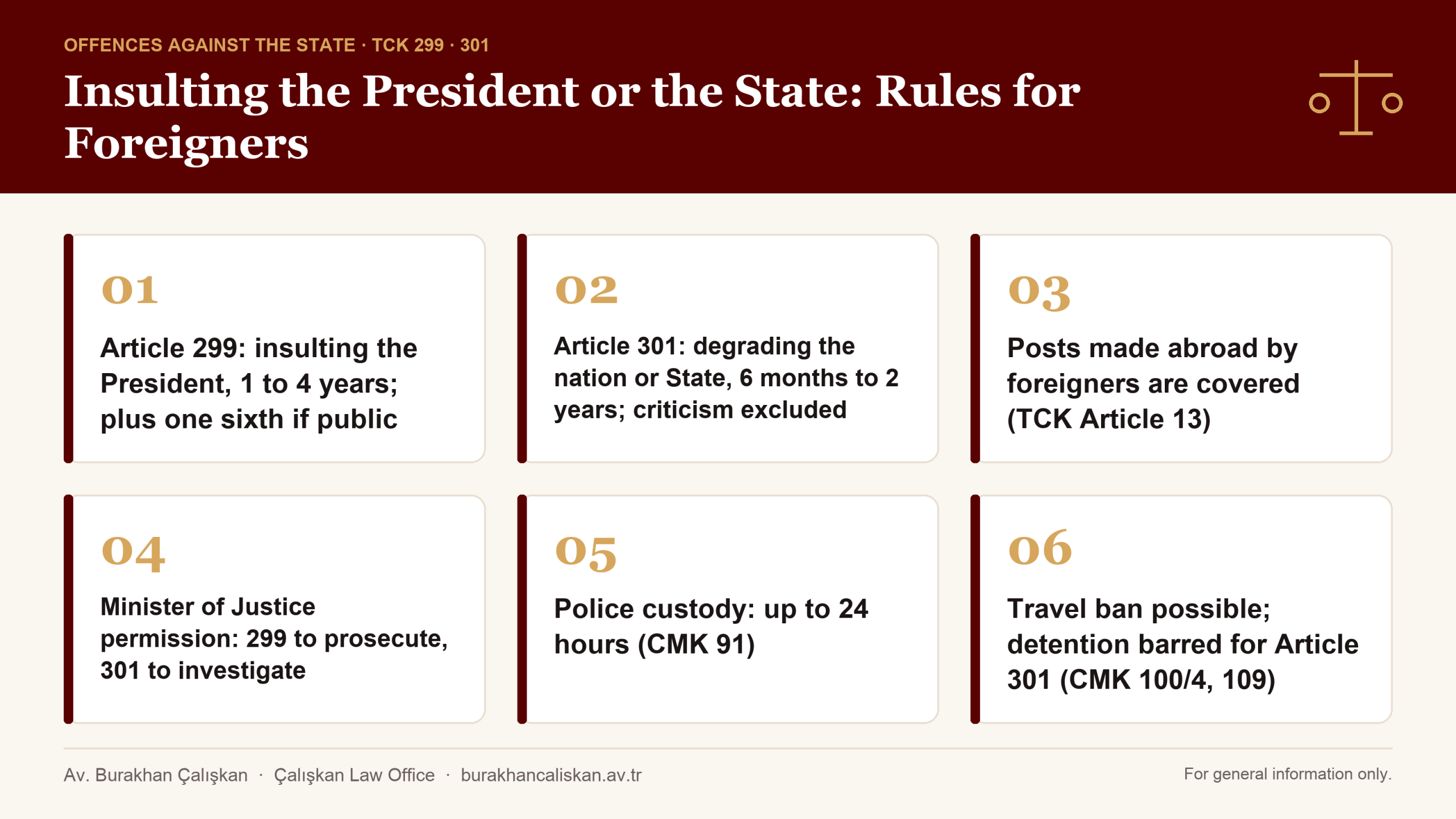
- Insulting the President carries one to four years in prison under Article 299 of the Turkish Penal Code (TCK), increased by one sixth if committed publicly.
- Publicly degrading the Turkish nation, the State or its institutions carries six months to two years under Article 301; criticism is expressly excluded.
- Article 13 of the TCK applies Turkish law to both offences even when a foreigner commits them abroad.
- Article 299 needs the Minister of Justice’s permission to prosecute; Article 301 needs it even to investigate.
Custody lasts up to 24 hours and the statement taken in that time stays in the file. To get information about your case, you can call or send a WhatsApp message.
What is the offence of insulting the President under Article 299?
Insulting the President (Cumhurbaşkanına hakaret) is an offence under Article 299 of the Turkish Penal Code (Türk Ceza Kanunu, TCK) committed by attacking the honour, dignity or reputation of the serving President of Turkey, in speech, writing, image or a social media post. The penalty is one to four years of imprisonment.
“A person who insults the President shall be punished with imprisonment from one year to four years.” (TCK Article 299/1, unofficial translation)
If the insult is committed publicly (alenen), the sentence is increased by one sixth (Article 299/2). The act itself is defined by the general insult offence in Article 125: attributing a concrete act or fact capable of offending a person’s honour, or swearing at them.
What does Article 301 cover, and how is it different?
Article 301 of the Turkish Penal Code punishes a person who publicly degrades (alenen aşağılama) the Turkish nation, the State of the Republic of Turkey, the Grand National Assembly, the Government or the judicial organs of the State with six months to two years of imprisonment. The same penalty applies to degrading the military or the police organisation.
Publicity is an element of this offence, so a private message does not fall under it. The article also carries its own exclusion clause:
“Expressions of thought made for the purpose of criticism do not constitute an offence.” (TCK Article 301/3, unofficial translation)
Does Turkish law apply to a post written abroad by a foreigner?
Turkish criminal law applies to Articles 299 and 301 wherever the act is committed and whatever the nationality of the author. Article 13/1-b of the Turkish Penal Code lists the chapter that contains Articles 299 to 301 among the offences prosecuted under Turkish law even when a foreigner commits them in another country.
For most offences committed abroad, Article 13/2 makes a trial in Turkey depend on a request by the Minister of Justice. This chapter is exempted, but the permission rules in Articles 299 and 301 themselves remain.
Why does the Minister of Justice’s permission matter?
The Minister of Justice’s permission is a procedural condition without which a case under Article 299 or Article 301 cannot proceed. Under Article 299/3 the prosecution (kovuşturma) depends on it; under Article 301/4 even the investigation (soruşturma) does. The prosecutor sends the file to the Ministry and waits for the answer.
Article 223/8 of the Code of Criminal Procedure (Ceza Muhakemesi Kanunu, CMK) sets out the result. If the condition has not yet been met, the court stays the case (durma). If it is clear that it will not be met, the court dismisses the case (düşme).
The Ministry of Justice had stated in writing that there was no ground to grant permission to prosecute under Article 299/3, yet the lower courts ruled on the merits. The Chamber held that the condition for prosecution had not been met and itself dismissed the case under CMK Article 223/8.
Where is the line between criticism and insult?
The line between criticism and insult under Articles 299 and 301 is drawn by asking whether the words attack honour and dignity, or whether they comment, even harshly, on conduct and policy. Courts read the expression as a whole, with its time, place and context, and not word by word.
The defendant had been convicted under Article 299 for social media posts. The Chamber found that the posts were political criticism that did not reach the level of offending honour and dignity, and quashed the conviction. It added that the one-sixth increase for publicity could not apply because the account was not open to the public.
The defendant had been convicted under Article 301 for Facebook posts. The Chamber held that the words were expressions of thought made for the purpose of criticism within the meaning of Article 301/3 and quashed the conviction because the elements of the offence were not present.
These judgments turn on their own facts and do not mean that every harsh post is protected. They show the points a defence can raise: context, the target of the words, and whether the account was public.
Can a foreigner be detained at the airport over a social media post?
A foreigner can be stopped at passport control if an apprehension order (yakalama emri) has been issued in an investigation under Article 299 or 301. Under CMK Article 98, a criminal judgeship of peace (sulh ceza hâkimliği) may issue such an order at the prosecutor’s request when a suspect could not be summoned or did not come.
FROM PASSPORT CONTROL TO THE JUDGE
Where the order was issued only to take a statement and the person is apprehended outside working hours, the prosecutor may order release against an undertaking to appear on a set date (CMK Article 94/3). The later stages are explained in our guide on how a criminal case works in Turkey.
Can the judge order pre-trial detention or a travel ban?
Pre-trial detention (tutuklama) is legally possible for Article 299 and barred for Article 301. CMK Article 100/4 prohibits detention for offences with a maximum prison term of two years or less, which covers Article 301. For Article 299, the judge needs concrete evidence of strong suspicion and a ground such as flight risk.
Judicial control (adli kontrol) under CMK Article 109 is the alternative, and Article 109/2 allows it even where detention is barred. Its first form is a ban on leaving the country; the objection period is two weeks from learning of the decision (CMK Article 268). See our guides on travel bans for foreigners in Turkish criminal cases and on deportation and entry bans after a criminal case.
What rights does a foreign suspect have during questioning?
A foreign suspect questioned in Turkey under Article 299 or 301 has the same procedural rights as a Turkish citizen under CMK Article 147: to be told the accusation, to have a lawyer present, to remain silent, to have a relative informed and to ask for evidence in their favour to be collected.
- Lawyer: you may choose one; if you cannot, the bar association appoints one at your request (CMK Articles 147 and 150).
- Interpreter: if you do not speak enough Turkish, the prosecutor or judge appoints one during the investigation (CMK Article 202/3).
- Challenge to custody: you, your lawyer, spouse or close relatives may apply to the criminal judgeship of peace for release (CMK Article 91/5).
What sentences are possible, and can they be deferred or suspended?
A conviction under Article 299 leads to a prison sentence between one and four years, and under Article 301 between six months and two years. A sentence of two years or less can be deferred through HAGB (hükmün açıklanmasının geri bırakılması, CMK Article 231) or suspended (TCK Article 51) if the legal conditions are met.
Worked example. A court takes the minimum of one year under Article 299/1. The post was on a public account, so one sixth (two months) is added: one year and two months. From the maximum of four years, the result is four years and eight months.
Deferral requires, among other conditions, no previous conviction for an intentional offence, and brings a five-year supervision period (CMK Article 231/6 and 231/8). The limitation period is eight years for both offences (TCK Article 66/1-e).
Common mistakes
The mistakes most often seen in files on insulting the President or the State involving foreigners are made in the first hours and concern evidence, statements and deadlines.
- Deleting the post or account after learning of the investigation. Screenshots are usually already in the file, and deletion can be argued as hiding evidence, a detention ground under CMK Article 100/2-b.
- Signing a statement that was not translated, or giving it without a lawyer.
- Assuming that an old post, or one made abroad, cannot be prosecuted.
More guides are under Criminal Law in Turkey and on our page about criminal defence in Istanbul. See also our article on the offence of insulting the President (in Turkish). Official texts: Turkish Penal Code (Turkish) and Code of Criminal Procedure (Turkish).
Frequently Asked Questions
Can a tourist be arrested in Turkey for a social media post about the President?
A tourist can be taken into custody and questioned if an investigation under Article 299 of the Turkish Penal Code is open. Police custody is limited to 24 hours.
Does it matter that I posted from my own country?
Not for jurisdiction. Article 13 of the Turkish Penal Code applies Turkish law to Articles 299 to 301 even when a foreigner commits the act abroad.
What is the penalty for insulting the President in Turkey?
Article 299 provides for one to four years of imprisonment. If the insult is public, the sentence is increased by one sixth, so the range becomes one year two months to four years eight months.
Is criticising the Turkish government a crime under Article 301?
Not in itself. Article 301/3 states that expressions of thought made for the purpose of criticism do not constitute an offence.
Can the case go ahead without the Minister of Justice’s permission?
No. Under Article 299/3 a prosecution, and under Article 301/4 even an investigation, depends on the Minister’s permission. If permission is refused, the case is dismissed under Article 223/8 of the Code of Criminal Procedure.
How long can a post be prosecuted after it was written?
The limitation period for offences punishable with up to five years of imprisonment is eight years under Article 66 of the Turkish Penal Code.
Whether permission was requested, what the file contains and which measures apply are the first points to check. To get information about your case, you can call or send a WhatsApp message.
About the Author
Av. Burakhan Çalışkan is a lawyer at Çalışkan Hukuk Bürosu in Kartal, Istanbul, working in criminal law. His work includes investigations and trials on insult offences committed through social media, custody and judicial control hearings before criminal judgeships of peace, and files of foreign nationals and of people living abroad who are questioned on entering Turkey.
Legal disclaimer: This article has been prepared for general information purposes only, based on current legislation and the court decisions cited. The assessments it contains are general explanations that may vary according to the specific circumstances of each case; they do not constitute legal advice and do not create a lawyer-client relationship. As legislation and case law may change over time, it is recommended that you consult a qualified lawyer before taking any step regarding a specific legal problem.