Short answer: Yes. A foreign national can be deported from Turkey because of a criminal investigation or conviction, even before any judgment, if the governorate considers them a threat to public order (Law No. 6458, Article 54/1-d). The decision can be challenged at the administrative court within seven days of notification, and the person is not removed while that case is pending unless they agree. Deportation normally brings an entry ban of up to five years.
- Deportation is an administrative decision of the governorate under Law No. 6458, separate from the criminal case.
- A conviction is not required: an investigation can be treated as a public order threat under Article 54/1-d.
- The decision can be challenged at the administrative court within seven days of notification, and removal is suspended meanwhile.
- Deportation is usually followed by an entry ban of up to five years, extendable by up to ten more for serious threats.
Families often learn about deportation only when the police hand the person to the migration office. This guide explains deportation and entry bans after a criminal case in Turkey: who decides, on what grounds, how to challenge it, detention and ban length.
The period runs from notification, not from release. To get information about your case, you can call or send a WhatsApp message.
Can a foreigner be deported from Turkey because of a criminal case?
A foreigner can be deported from Turkey because of a criminal case in two main situations. Under Law No. 6458 on Foreigners and International Protection, deportation follows either a sentence reported under the Turkish Penal Code (Article 54/1-a) or an assessment that the person threatens public order, public security or public health (Article 54/1-d).
Deportation (sınır dışı etme) is an administrative measure, not a criminal penalty. It runs in parallel with the criminal case, so both files must be followed. See the Law on Foreigners and International Protection (Turkish).
For sexual offence investigations against foreigners, see accused of a sexual offence in Turkey as a foreign national.
Who decides on deportation, and how quickly?
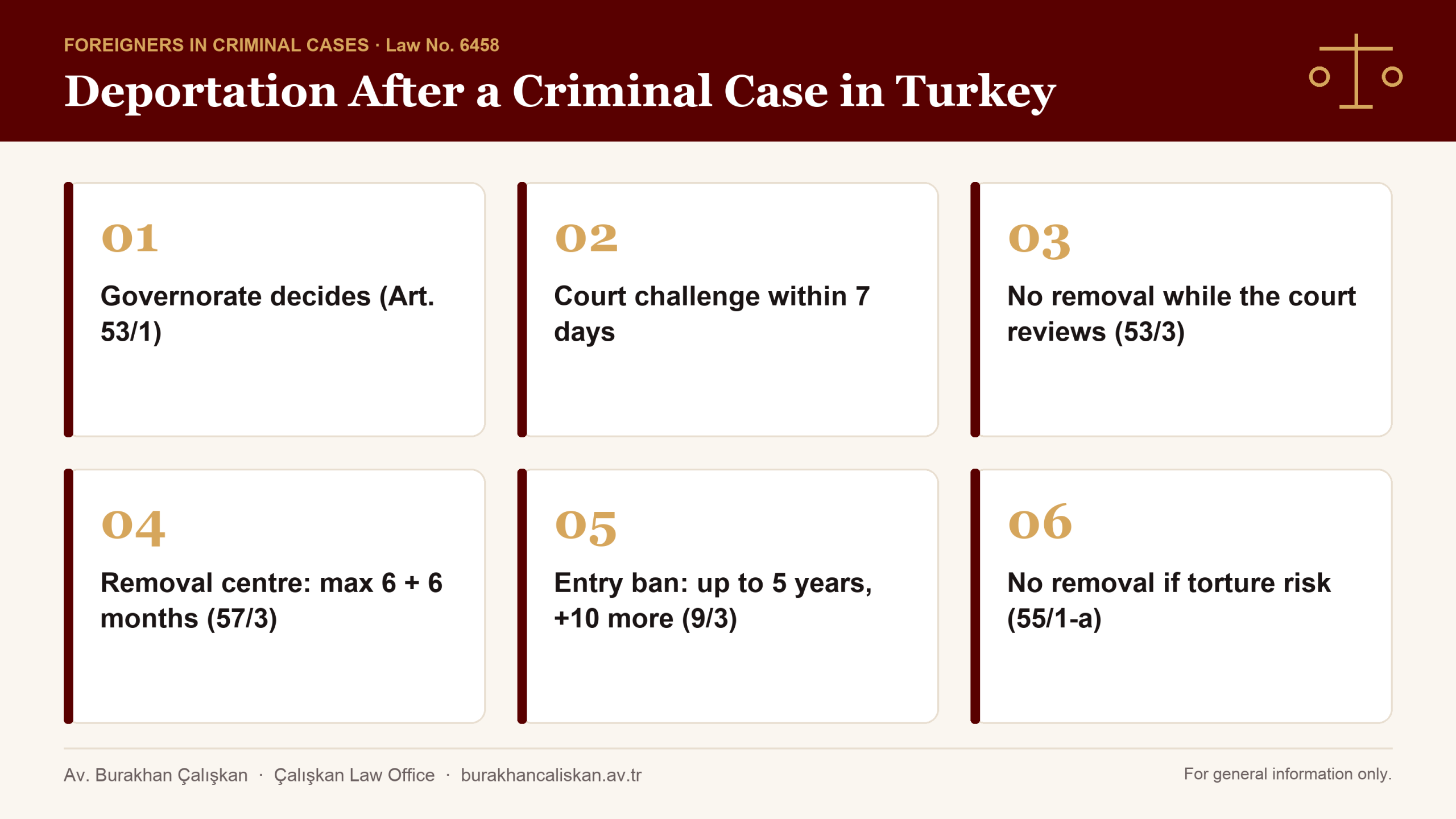
The governorate (valilik) decides on deportation in Turkey, on its own initiative or on instruction from the central migration authority (Article 53/1). When the police apprehend a foreigner covered by Article 54, they must inform the governorate immediately, and the assessment and decision may not take longer than 48 hours (Article 57/1).
The decision is notified with its reasons; a person without a lawyer must be told how and when to object (Article 53/2). Keep the notification form: the deadline runs from that date.
Which grounds of Article 54 are used after a criminal case?
Article 54/1 of Law No. 6458 lists the foreigners against whom a deportation decision is taken. In criminal files four grounds appear most often: a sentence reported under the Turkish Penal Code, organisation membership, a threat to public order, and returning despite an entry ban.
Under TCK Article 59, a sentenced foreigner is reported to the Ministry of Interior for deportation assessment once the sentence is served or probation or conditional release is ordered.
A separate ground, Article 54/1-c, covers forged documents used in entry, visa or residence permit procedures; see fake passport, visa or residence permit charges in Turkey.
Is a conviction required for deportation?
A conviction is not required for deportation from Turkey. Article 54/1-d covers foreigners who pose a threat to public order, and the Constitutional Court treats deportation as outside the criminal-charge guarantees of a fair trial. An open investigation can be the factual basis, but the authority must still show a concrete threat.
An Iranian national was deported under Article 54/1-d, with six months’ administrative detention, after an investigation for possessing drugs for personal use. His complaint that he had not been convicted was declared inadmissible because deportation does not concern a criminal charge; his ill-treatment claim failed as unsupported and inconsistent.
For a Ukrainian national, the public order and public health ground was found not concretely proven, so the public-health entry ban (code Ç-116) was annulled; the deportation and the code Ç-117 ban stood because unauthorised work was proven. The authority’s appeal was rejected.
Each ground and ban code is reviewed separately. For drug files, see drug possession for personal use in Turkey (Article 191).
Who cannot be deported from Turkey?
Article 55 of Law No. 6458 protects foreigners from deportation even if Article 54 applies. The key group in criminal files is people facing serious indications of the death penalty, torture or inhuman or degrading treatment in the destination country (55/1-a). Serious illness, age, pregnancy and trafficking or violence victims are also protected.
After a personal-use drug investigation, an Iranian national was ordered deported to an unnamed third country although he had filed a translated Iranian death sentence. The Court held that the administrative court should have checked whether that judgment existed and was final, and that a decision not naming the destination cannot prevent indirect return. It found violations of the right to life and the prohibition of ill-treatment.
These criteria mirror Articles 2 and 3 of the European Convention on Human Rights.
A foreigner wanted by another state is not simply deported there; the separate court procedure is explained in extradition from Turkey and Interpol red notices.
Victims of violence are protected from removal until their treatment ends; see protection orders for foreign spouses under Law No. 6284.
How do you challenge a deportation decision in Turkey?
A deportation decision in Turkey is challenged by filing a case at the administrative court (idare mahkemesi) within seven days of notification (Article 53/3). The foreigner, their representative or lawyer files the case and informs the authority that issued the decision. During the period and the proceedings, the person is not deported unless they consent.
“Subject to the consent of the foreigner, the foreigner shall not be deported during the period for filing a case or, where judicial recourse has been sought, until the proceedings are concluded.” (Law No. 6458 Article 53/3, unofficial translation)
FROM POLICE HANDOVER TO A FINAL RULING
The current text, rewritten by Law No. 7533 in November 2024, has no exception for public order cases. Lawyers often challenge the deportation and the entry ban in one petition. A Turkish template: deportation objection petition (in Turkish).
How long can administrative detention in a removal centre last?
Administrative detention (idari gözetim) in a removal centre may not exceed six months, extendable by up to six more months only if removal fails because the foreigner does not cooperate or gives false information about their country (Article 57/3). The governorate reviews it every month (Article 57/4).
Detention can be challenged before the criminal judgeship of peace (sulh ceza hâkimliği), which decides within five days; the application does not stop detention, but can be repeated if circumstances change (Article 57/6). Article 57/A offers alternatives for up to 24 months, such as a set address, reporting, a guarantee or electronic monitoring.
How long does an entry ban to Turkey last, and can it be lifted?
An entry ban to Turkey lasts at most five years, but the central migration authority can extend it by up to ten more years where there is a serious threat to public order or security (Article 9/3). Under Article 9/2, the entry of foreigners deported from Turkey is banned by the migration authority or the governorate.
Bans are recorded as restriction codes; the judgments above mention codes such as Ç-116, Ç-117 and O-100. The authority may lift a ban or allow entry for a set period, for example for a hearing (Article 9/6).
What happens when a foreign prisoner finishes the sentence?
A foreign prisoner who finishes the sentence, or is granted probation or conditional release, is reported to the Ministry of Interior under TCK Article 59 for deportation assessment. In practice, release is often followed by a handover to the migration office and detention.
During the sentence, prisoner transfer under Article 32 of Law No. 6706 requires a final judgment, the prisoner’s consent, dual criminality and normally at least six months remaining; see our guide on drug smuggling charges in Turkey.
If the prisoner would rather serve the rest of the sentence at home, the conditions and procedure are explained in our guide on prisoner transfer from Turkey.
What if the criminal case is still pending?
A pending criminal case does not prevent deportation, but a judge may have banned the suspect from leaving Turkey as judicial control (CMK Article 109/3-a). A foreigner who must stay at a court’s request may receive a short-term residence permit for up to two years at a time (Article 31/1-g). See how a criminal case works in Turkey.
For the court-ordered ban on leaving Turkey, see travel bans and judicial control in Turkey.
How do courts weigh family life against deportation?
Turkish courts must strike a fair balance between public order and the family life of a foreigner with strong ties in Turkey. The Constitutional Court applies the right to respect for family life under Article 20 of the Constitution, close to Article 8 of the European Convention, and requires reasoned decisions rather than bare references to public order.
A Syrian national who said he had lived in Turkey with his family for about nine years was deported while an insult and threat investigation, arising from a dispute with relatives, was pending. The administrative court ignored his family; the Constitutional Court found a violation and ordered a retrial.
Common mistakes
- Counting the seven days from release instead of from notification.
- Signing a voluntary return form without realising that consent allows removal during the case.
- Raising the risk of ill-treatment late or inconsistently, as in Karami.
- Not filing a non-prosecution decision or acquittal with the court.
- Assuming the entry ban ends when the person flies home.
Families abroad can find first steps in my family member was arrested in Turkey. More guides: Criminal Law in Turkey and criminal defence for foreigners in Istanbul.
Frequently Asked Questions
Can I be deported from Turkey if I was acquitted?
It is possible. An acquittal or non-prosecution decision is strong evidence but does not automatically cancel deportation; the court asks whether the facts show a real public order threat. File it with the court promptly.
Who pays for the flight when a foreigner is deported?
The foreigner pays from their own money; if they have none, the migration authority pays (Article 60/3 of Law No. 6458). Until costs paid by the authority are repaid, entry to Turkey may be refused.
Can my family contact me in the removal centre?
Yes. Article 59 of Law No. 6458 gives detainees access to relatives, a notary, a lawyer and telephone services,, plus meetings with visitors, consular officials and UNHCR staff.
Is the administrative court’s decision on deportation final?
Yes. Article 53/3 makes the ruling final, so there is no ordinary appeal. Where family life or the ban on ill-treatment is at stake, an individual application to the Constitutional Court (Anayasa Mahkemesi) remains possible.
Will I get time to leave Turkey voluntarily?
Usually not after a criminal case. Article 56 gives fifteen to thirty days to leave, but not to people considered a public order threat, at risk of absconding or who broke entry and exit rules.
Can a deported foreigner ever return to Turkey?
Yes, once the ban expires or is lifted. Article 9/6 allows the migration authority to lift a ban or permit entry for a set period while the ban remains, and Article 9/7 allows entry to be made subject to prior permission.
The criminal file, the deportation decision and the entry ban can be assessed together. To get information about your case, you can call or send a WhatsApp message.
About the Author
Av. Burakhan Çalışkan is a lawyer at Çalışkan Hukuk Bürosu in Kartal, Istanbul, working in criminal law. His practice includes files of foreign nationals whose investigations or sentences lead to deportation, administrative detention and entry bans under Law No. 6458, where the criminal defence and the immigration consequences are handled together.
Legal disclaimer: This article has been prepared for general information purposes only, based on current legislation and established legal practice. The assessments it contains are general explanations that may vary according to the specific circumstances of each case; they do not constitute legal advice and do not create a lawyer-client relationship. As legislation and case law may change over time, it is recommended that you consult a qualified lawyer before taking any step regarding a specific legal problem.